
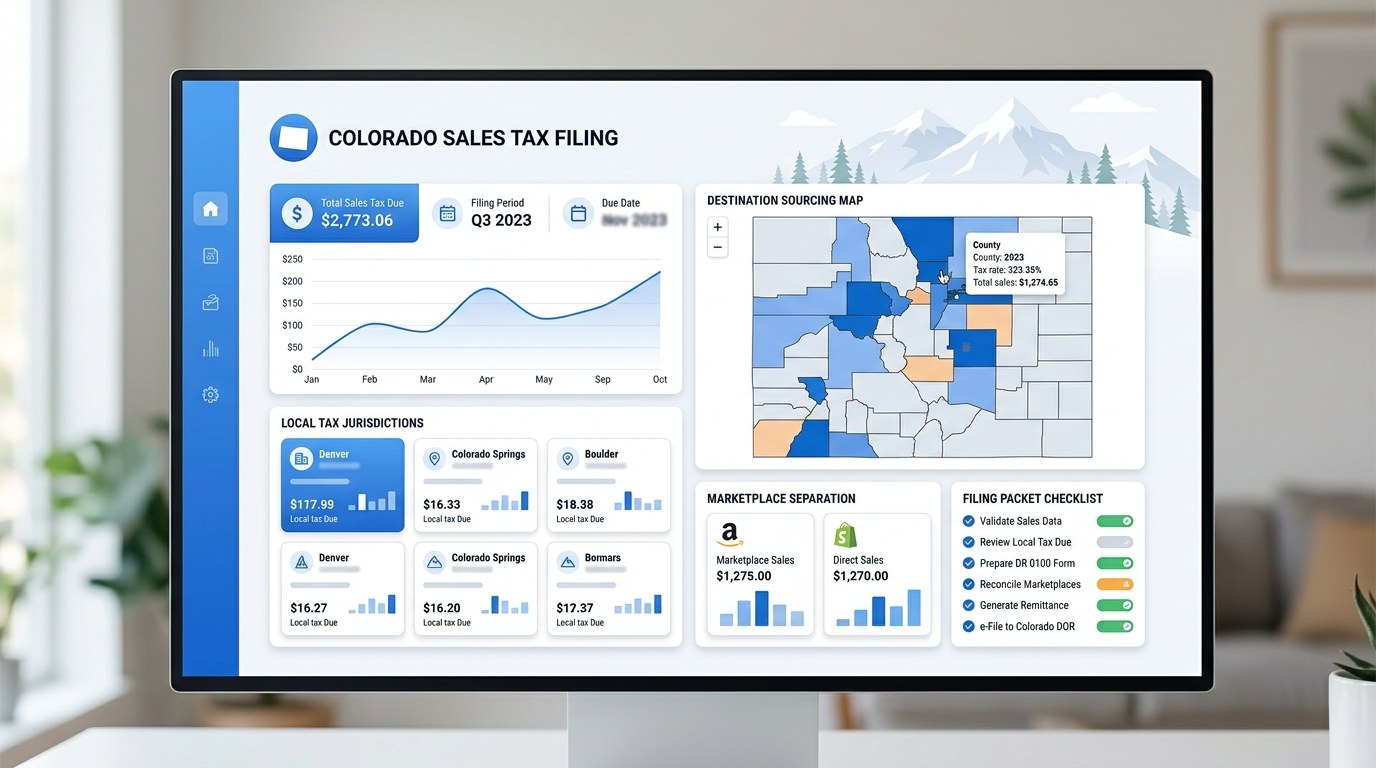
Colorado remote seller sales threshold.
Delivered sales are generally sourced to where the buyer receives the item.
State and state-administered local taxes may apply.
Quick answer for ecommerce sellers.
Colorado generally exempts retailers without a physical location in Colorado from state sales tax licensing and collection requirements if their annual retail sales of tangible personal property, commodities, and services into Colorado are less than $100,000 in both the current and previous calendar years. Once the threshold is exceeded, Colorado sales tax registration and collection workflows need review.
Colorado also uses destination sourcing for many delivered sales: a retail sale delivered to the purchaser away from the seller's business location is generally sourced to where the purchaser receives the property or first uses the service. That makes destination and local-tax support central to the filing packet.
What creates Colorado sales tax nexus?
- Economic nexus: $100,000 or more in Colorado retail sales generally creates collection responsibilities for remote sellers.
- Physical presence: employees, inventory, offices, warehouses, events, contractors, or property can create obligations.
- Destination sourcing: delivered sales are usually sourced to the location where the purchaser receives the item or first uses the service.
- Local taxes: state-administered local taxes can apply in addition to state tax.
- Marketplace sales: platform-collected sales should be separated from direct merchant-collected sales.
How Colorado registration fits into the workflow.
After Colorado is active, save the sales tax license, account number, filing frequency, portal owner, local-tax process, marketplace treatment, payment method, and reviewer assignment. The packet should also explain whether Colorado is active because of economic nexus, physical presence, marketplace activity, or voluntary collection.
If the seller remains below the threshold and does not collect, Colorado notice and reporting rules may matter. That status should be documented instead of ignored.
Collection and marketplace treatment.
Colorado returns are easiest when the source reports preserve delivery destination. Direct sales need tax and local-jurisdiction support; marketplace-facilitated sales need evidence that the facilitator collected tax.
- Separate direct ecommerce sales from marketplace-facilitated sales.
- Preserve ship-to address, rate, and jurisdiction support.
- Track gross sales, taxable sales, exempt sales, and tax collected.
- Save refunds, credits, cancellations, and tax refunds.
- Keep exemption and resale documentation with the filing period.
How to prepare a Colorado filing packet.
- Export exact-period reports: direct orders, marketplace reports, refunds, exemptions, tax collected, and accounting support.
- Confirm nexus: document Colorado sales against the $100,000 threshold.
- Map destination data: summarize sales by destination and applicable state-administered local tax.
- Reconcile channels: split direct and marketplace-facilitated sales.
- Review cadence: confirm filing frequency and due date.
- Archive proof: save source exports, return confirmation, payment receipt, and reviewer notes.
Colorado is also a good state for testing whether the business can preserve local tax detail without slowing the close. If every filing requires a fresh rebuild of ship-to locations, the workflow should be improved before more states are added.
For review, keep one summary tab for state totals and one backup tab for destination support. That makes the return easier to approve and gives the business a stronger record if a local tax question appears later.
Risk controls for Colorado.
Colorado risk often comes from missing destination sourcing, using a single state total without local support, or duplicating marketplace sales. The packet should let a reviewer trace state and local figures back to source transactions.
- Was the $100,000 threshold reviewed for current and prior years?
- Does the packet preserve destination-level support?
- Were marketplace-facilitated sales separated?
- Are refunds and exemptions supported?
- Was filing proof archived after submission?
Colorado sales tax FAQ.
What is Colorado economic nexus?
Remote retailers generally must review registration and collection when annual Colorado retail sales reach $100,000 or more.
How does Colorado source delivered sales?
Colorado generally sources delivered sales to the location where the purchaser receives the property or first uses the service.
Do Colorado local taxes matter?
Yes. State-administered local taxes can apply, so destination and local-tax support should be preserved.
Can AtomicTax help file Colorado returns?
Yes. AtomicTax prepares Colorado filing packets and completes standard sales tax filings for $45 per filing.
Official Colorado resources to check.
Need help making Colorado filings repeatable?
AtomicTax prepares reviewable sales tax filing packets from ecommerce reports, separates marketplace and direct-channel activity, and completes standard filings for $45 per filing.