
Best for monthly and quarterly filing workflows.
Useful for storefront, marketplace, payment, and accounting data.
Data still needs review, mapping, and archived proof.
Quick answer.
Connected data sources are usually better than one-off uploads when a merchant files sales tax in multiple states on a recurring schedule. Shopify tax reporting, for example, can provide state, jurisdiction, and transaction-level views for U.S. sales tax, while order exports can provide order and transaction details. Those reports become more valuable when they feed a repeatable filing workflow instead of sitting in separate downloads.
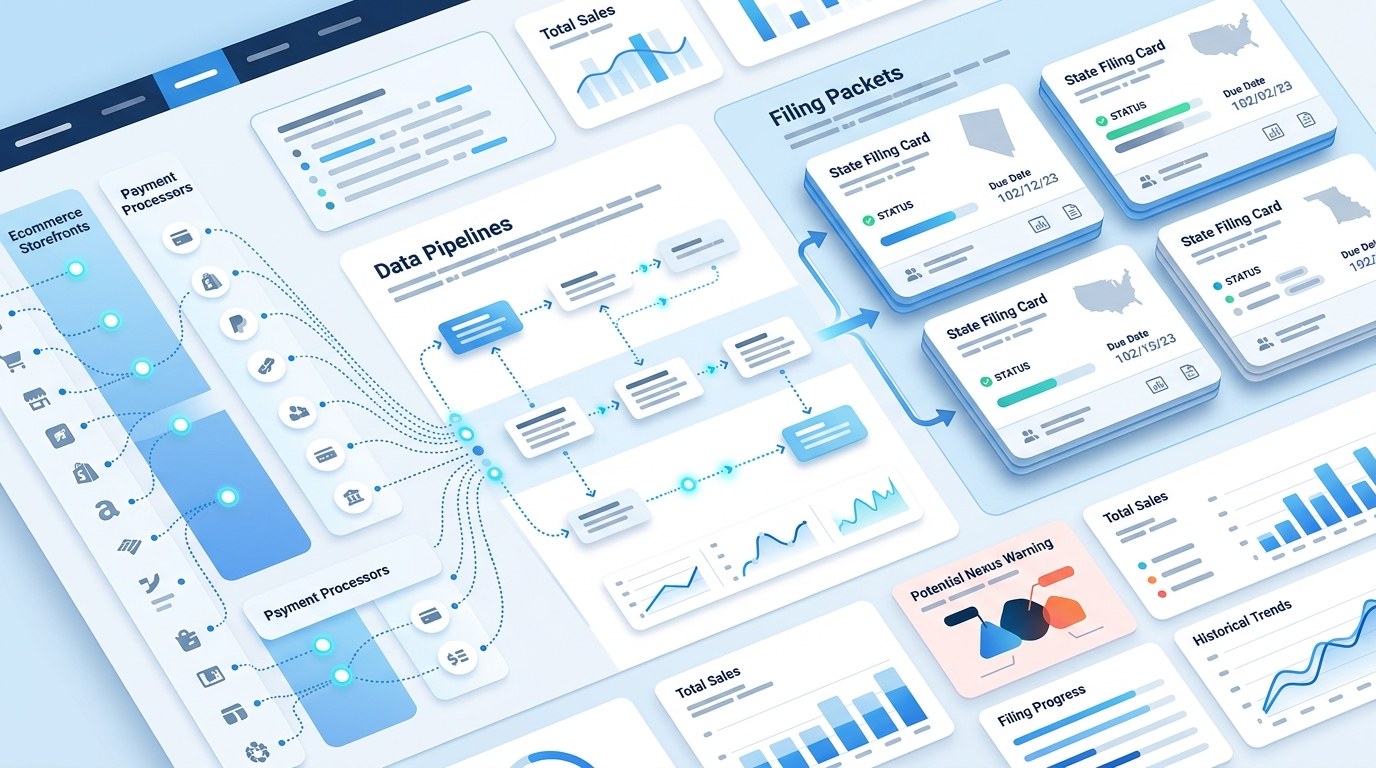
AtomicTax uses connected sources, exports, and uploaded files to prepare filing packets. The connection is not the finish line. The finish line is a packet that shows what was filed, why those numbers were used, what was excluded, who reviewed it, and where proof was saved.
Connected sources that matter for sales tax filing.
Most merchants need more than one data source because sales, payments, refunds, marketplaces, and accounting records live in different systems.
- Storefronts: Shopify, WooCommerce, BigCommerce, Wix, and custom ecommerce stores.
- Marketplaces: Amazon, Walmart, eBay, Etsy, TikTok Shop, and other facilitator channels.
- Billing systems: Stripe, PayPal, subscription apps, invoicing tools, and payment processors.
- Accounting systems: QuickBooks, Xero, NetSuite, and finance close reports.
- Warehouse or ERP data: shipment destinations, returns, inventory, and product mappings.
- Uploaded files: CSV, Excel, and PDF reports when direct connections are incomplete.
Fields every connected-source workflow still needs.
Connectivity does not remove the need for filing fields. A clean integration should preserve the same evidence you would want in a CSV or Excel packet.
- Transaction ID and order date.
- Filing period and source system.
- Customer destination state, ZIP code, and jurisdiction when available.
- Sales channel and marketplace facilitator status.
- Gross sales, taxable sales, exempt sales, and deductions.
- Tax collected, tax refunded, and net tax due.
- Refunds, cancellations, discounts, and shipping treatment.
- Exemption certificate or resale support.
How connected data becomes a filing packet.
- Connect or ingest sources: pull storefront, marketplace, billing, and accounting data for the period.
- Normalize channels: separate direct merchant-collected sales from marketplace-facilitated sales.
- Map states: identify active states, watch-list states, and states that do not require filing.
- Reconcile totals: compare source sales, tax collected, refunds, payment deposits, and accounting entries.
- Prepare filing summaries: create state-ready totals with notes for exceptions and adjustments.
- File and archive: save source data, return confirmation, payment proof, and reviewer approval together.
Where connected-source filing can still go wrong.
A connected source can still produce a bad filing packet if the data is incomplete or misunderstood. Common risks include missing historical data, duplicate marketplace orders, refunds posting in a different period, deleted orders, platform tax settings changing mid-period, and accounting totals that do not match order-level exports.
The right workflow keeps a review layer between raw data and the filed return. That review layer catches missing states, unexpected tax amounts, refund timing issues, and marketplace sales that should not be reported as merchant-collected tax.
Connected-source filing checklist.
- Which source is authoritative for each sales channel?
- Does the connection cover the exact filing period?
- Are marketplace-facilitated sales marked clearly?
- Are refunds and tax refunds included?
- Can state and jurisdiction totals be traced back to transactions?
- Does accounting reconcile to the source data?
- Are registrations and filing frequencies tracked outside the raw data?
- Is the filed return archived with confirmation and payment proof?
FAQ.
Are connected data sources better than CSV uploads?
For recurring multi-state filing, connected sources often reduce repeated export work. CSV uploads can still be useful for backup, validation, or sources that do not connect cleanly.
Does connecting Shopify automatically solve sales tax filing?
No. Shopify and other platforms can provide valuable tax data, but filings still require state mapping, marketplace separation, review, and archived proof.
What sources can support a sales tax filing packet?
Storefronts, marketplaces, payment processors, accounting systems, ERPs, warehouses, CSV files, Excel workbooks, and PDFs can all support a packet when the fields are clear.
Can AtomicTax file from connected sources?
Yes. AtomicTax can use connected or uploaded source data to prepare filing packets and complete standard filings for $45 per filing.
Sources and references.
Want less export chaos?
AtomicTax can turn connected and uploaded source data into reviewable state filing packets and recurring sales tax filings.