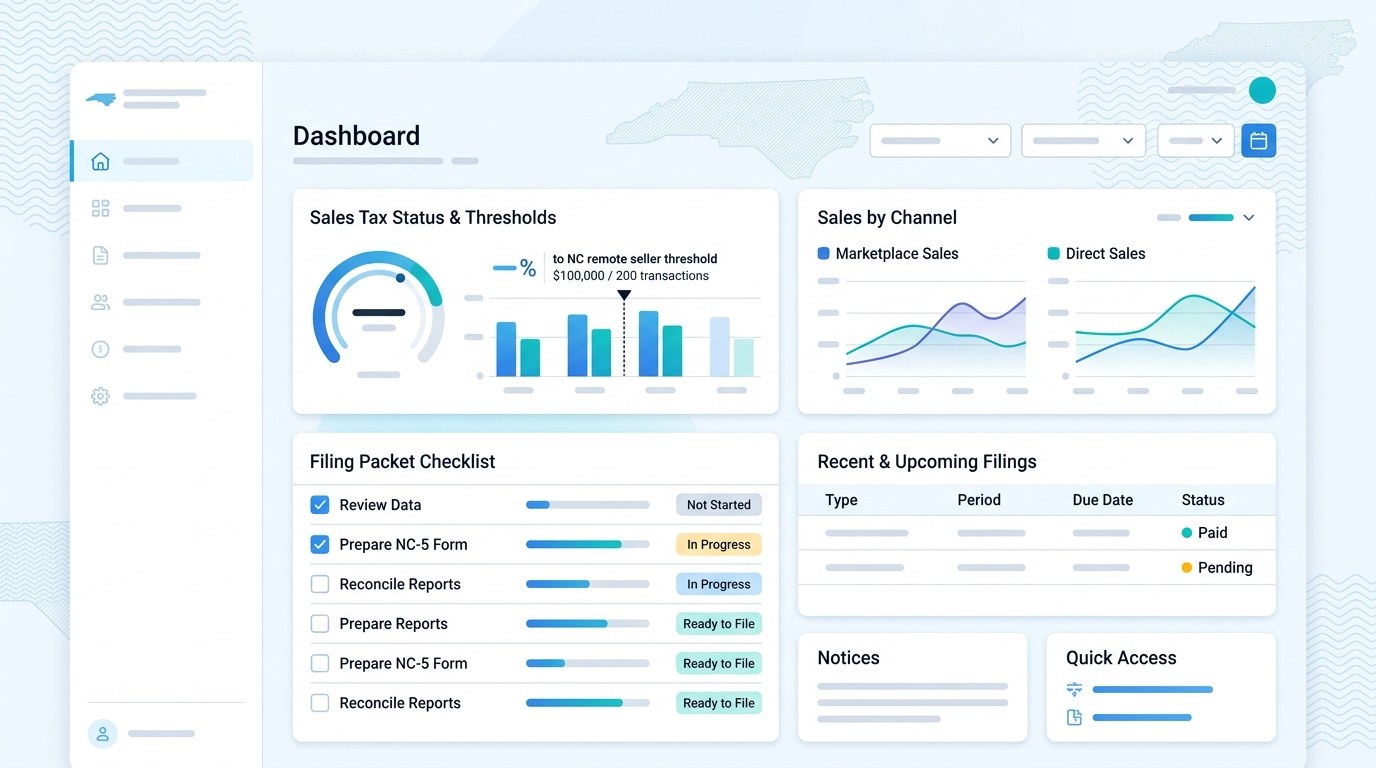
Current North Carolina remote seller sales threshold.
Transaction threshold repealed.
Separate marketplace and direct sales before filing.
Quick answer for ecommerce sellers.
North Carolina changed its remote seller rules effective July 1, 2024. The state repealed the transaction threshold, so current remote seller analysis focuses on whether a retailer makes gross sales over $100,000 from remote sales sourced to North Carolina during the previous or current calendar year. Marketplace facilitators use a similar $100,000 gross-sales threshold that includes facilitated sales.
For ecommerce merchants, the filing workflow should preserve North Carolina source sales, marketplace and direct-channel separation, tax collected, refunds, exemption support, and the reason the state is active. A seller previously registered only because of transaction count should review whether registration still makes sense under the newer sales-only threshold.
What creates North Carolina sales tax nexus?
- Economic nexus: gross sales over $100,000 from remote sales sourced to North Carolina in the previous or current calendar year.
- Transaction threshold: repealed effective July 1, 2024, so do not use the old 200-transaction test for current analysis.
- Marketplace facilitator nexus: facilitators exceed the threshold with over $100,000 in North Carolina-sourced gross sales including facilitated sales.
- Physical presence: employees, inventory, events, warehouses, offices, or contractors can create obligations.
- Marketplace seller sales: marketplace sales are included when testing a retailer's remote-sales threshold, but return treatment still needs review.
How North Carolina registration fits into the workflow.
Once North Carolina is active, save the certificate of registration, account number, filing frequency, portal owner, payment method, and reviewer assignment. If the account was opened under the old transaction threshold, document whether it remains required under the current $100,000 gross-sales rule.
Registration notes should also explain the source of North Carolina sales: direct ecommerce, marketplace, wholesale, subscriptions, physical presence, or a combination. Those notes help future reviewers understand why the filing calendar includes the state.
Collection and marketplace treatment.
North Carolina collection depends on product taxability, customer destination, channel, and whether a marketplace collected tax. Do not let marketplace-facilitated sales create duplicate merchant-collected tax in the return packet.
- Separate direct sales from marketplace-facilitated sales before filing.
- Preserve destination and state sourcing support.
- Track gross sales, taxable sales, exempt sales, refunds, and tax collected.
- Save resale and exemption documentation with the filing period.
- Review platform tax settings if collection changed mid-period.
How to prepare a North Carolina sales tax filing packet.
- Export exact-period data: direct orders, marketplace reports, refunds, exemptions, tax collected, and accounting support.
- Confirm threshold status: document the current $100,000 gross-sales rule and why the state is active.
- Separate channels: split marketplace-facilitated and direct merchant-collected sales.
- Map return totals: gross sales, taxable sales, exempt sales, tax collected, deductions, and adjustments.
- Review due date and cadence: use the account's assigned filing frequency.
- Archive proof: save source reports, filing confirmation, payment receipt, and reviewer notes.
Risk controls for North Carolina.
The biggest current risk is using outdated transaction-threshold logic. Other common issues include duplicate marketplace reporting, refund timing mismatches, unsupported exemptions, and a filing packet that does not tie to the exact period.
- Was the old transaction threshold removed from the state map?
- Are gross North Carolina sales tracked against the $100,000 rule?
- Were marketplace sales reviewed separately?
- Do refunds and exemptions tie to source records?
- Was proof saved after filing and payment?
North Carolina sales tax FAQ.
What is North Carolina economic nexus now?
North Carolina remote sellers are engaged in business when gross sales from remote sales sourced to North Carolina exceed $100,000 in the previous or current calendar year.
Does North Carolina still have a transaction threshold?
No. North Carolina repealed the transaction threshold effective July 1, 2024.
Do marketplace sales matter in North Carolina?
Yes. North Carolina includes sales as a marketplace seller in the remote-seller sales threshold, and marketplace facilitator rules also use a $100,000 gross-sales threshold.
Can AtomicTax help file North Carolina returns?
Yes. AtomicTax prepares filing packets and completes standard sales tax filings for $45 per filing.
Official North Carolina resources to check.
Need help making North Carolina filings repeatable?
AtomicTax prepares reviewable sales tax filing packets from ecommerce reports, separates marketplace and direct-channel activity, and completes standard filings for $45 per filing.