Pennsylvania annual gross sales threshold.
No transaction-count requirement.
Gross sales include taxable and nontaxable sales across channels.
Quick answer for ecommerce sellers.
Pennsylvania requires online sellers and marketplace facilitators with economic presence to register, collect, and remit Pennsylvania sales tax when they have Pennsylvania annual gross sales greater than $100,000. Pennsylvania states that economic presence is measured by the sales threshold only and that there is no transaction-count requirement.
Gross sales include taxable and nontaxable sales across channels. A marketplace facilitator without physical presence should use both direct and facilitated sales when determining whether it exceeds the threshold, while a marketplace seller should generally use its direct sales and sales through a marketplace facilitator that does not collect on its behalf.
What creates Pennsylvania sales tax nexus?
- Economic nexus: annual Pennsylvania gross sales greater than $100,000.
- No transaction threshold: Pennsylvania economic presence uses sales threshold only.
- Marketplace facilitator role: facilitators can have collection responsibilities based on facilitated and direct sales.
- Physical presence: inventory, employees, offices, warehouses, contractors, or events can create obligations.
- Marketplace seller role: sellers need to understand whether the facilitator collects on their behalf.
How Pennsylvania registration fits into the workflow.
Once Pennsylvania is active, save the registration confirmation, account number, filing frequency, portal owner, payment method, marketplace status, and reviewer assignment. The account notes should explain whether the business is a vendor, marketplace seller, marketplace facilitator, or more than one role.
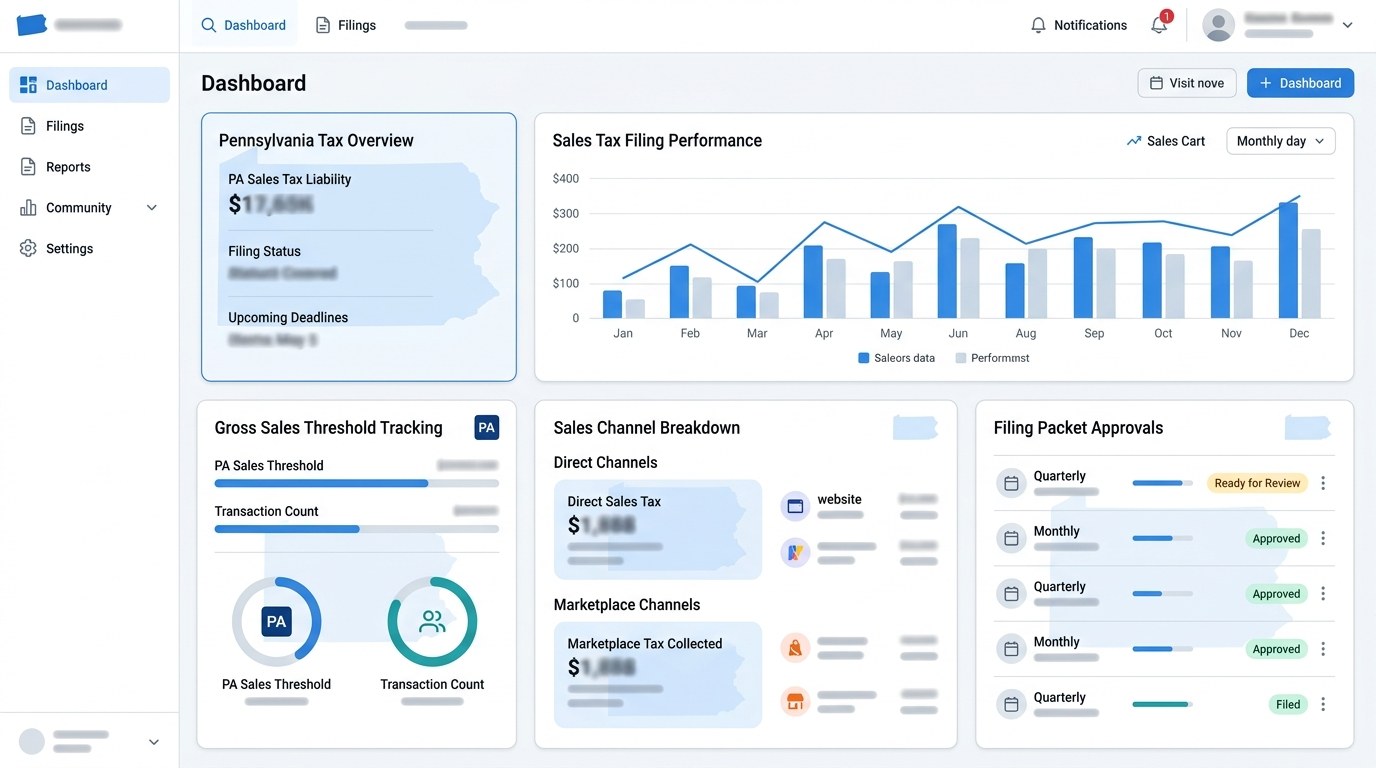
Because Pennsylvania's threshold is based on gross sales, the filing packet should not include only taxable sales. Keep nontaxable and exempt sales support available for threshold and return review.
Collection and marketplace treatment.
Pennsylvania collection depends on product taxability, channel, and whether a marketplace collected the tax. Marketplace and direct sales should be separated before the return is prepared.
- Track Pennsylvania gross sales across direct and relevant marketplace channels.
- Separate facilitator-collected sales from merchant-collected direct sales.
- Preserve taxable, nontaxable, exempt, and refund support.
- Save resale and exemption records with the period packet.
- Reconcile tax collected to the return before filing.
How to prepare a Pennsylvania filing packet.
- Export exact-period data: direct orders, marketplace reports, refunds, tax collected, exemptions, and accounting support.
- Confirm threshold status: document annual gross sales and the role of marketplace sales.
- Map return totals: summarize gross, taxable, exempt, refund, and tax-collected amounts.
- Separate channels: avoid duplicating marketplace-facilitated tax.
- Review cadence: confirm filing frequency and due date in the account.
- Archive proof: save return confirmation, payment receipt, source reports, and reviewer notes.
Because Pennsylvania looks at annual gross sales, the threshold review should not be limited to taxable sales or sales tax collected. Keep direct, marketplace, taxable, nontaxable, exempt, and refunded sales visible enough for another reviewer to understand the calculation.
If marketplace collection changed during the year, add a period note. That prevents the team from counting facilitated sales incorrectly when reviewing whether Pennsylvania registration or collection should continue.
For recurring review, save the gross-sales threshold calculation next to the return packet. That makes it easier to confirm whether Pennsylvania remains active when sales mix, marketplaces, or product taxability changes during the year.
Risk controls for Pennsylvania.
Pennsylvania risk often comes from treating the threshold as taxable sales only, using an outdated transaction-count concept, or mixing marketplace and direct-channel sales without clear deduction support.
- Was the $100,000 gross-sales threshold reviewed?
- Were taxable and nontaxable sales both visible?
- Were marketplace-collected sales separated?
- Are exemptions and refunds supported?
- Was filing proof archived after submission?
Pennsylvania sales tax FAQ.
What is Pennsylvania economic nexus?
Pennsylvania requires collection when annual Pennsylvania gross sales are greater than $100,000.
Does Pennsylvania have a transaction threshold?
No. Pennsylvania states that economic presence is measured by sales threshold only and there is no transaction-count requirement.
Do marketplace sales count?
Marketplace facilitators use direct and facilitated sales for their threshold. Marketplace sellers should review direct sales and marketplace sales where the facilitator does not collect on their behalf.
Can AtomicTax help file Pennsylvania returns?
Yes. AtomicTax prepares Pennsylvania filing packets and completes standard sales tax filings for $45 per filing.
Official Pennsylvania resources to check.
Need help making Pennsylvania filings repeatable?
AtomicTax prepares reviewable sales tax filing packets from ecommerce reports, separates marketplace and direct-channel activity, and completes standard filings for $45 per filing.