Tennessee remote seller sales threshold.
Online-sales guidance references previous 12 months.
Tennessee filing and account portal.
Quick answer for ecommerce sellers.
Tennessee requires remote sellers with no physical presence to register and collect Tennessee sales tax when they have Tennessee sales in excess of $100,000. Tennessee guidance for online sales by out-of-state sellers also describes the threshold as more than $100,000 in sales in the previous 12 months for out-of-state dealers with regular solicitation or other nexus activity.
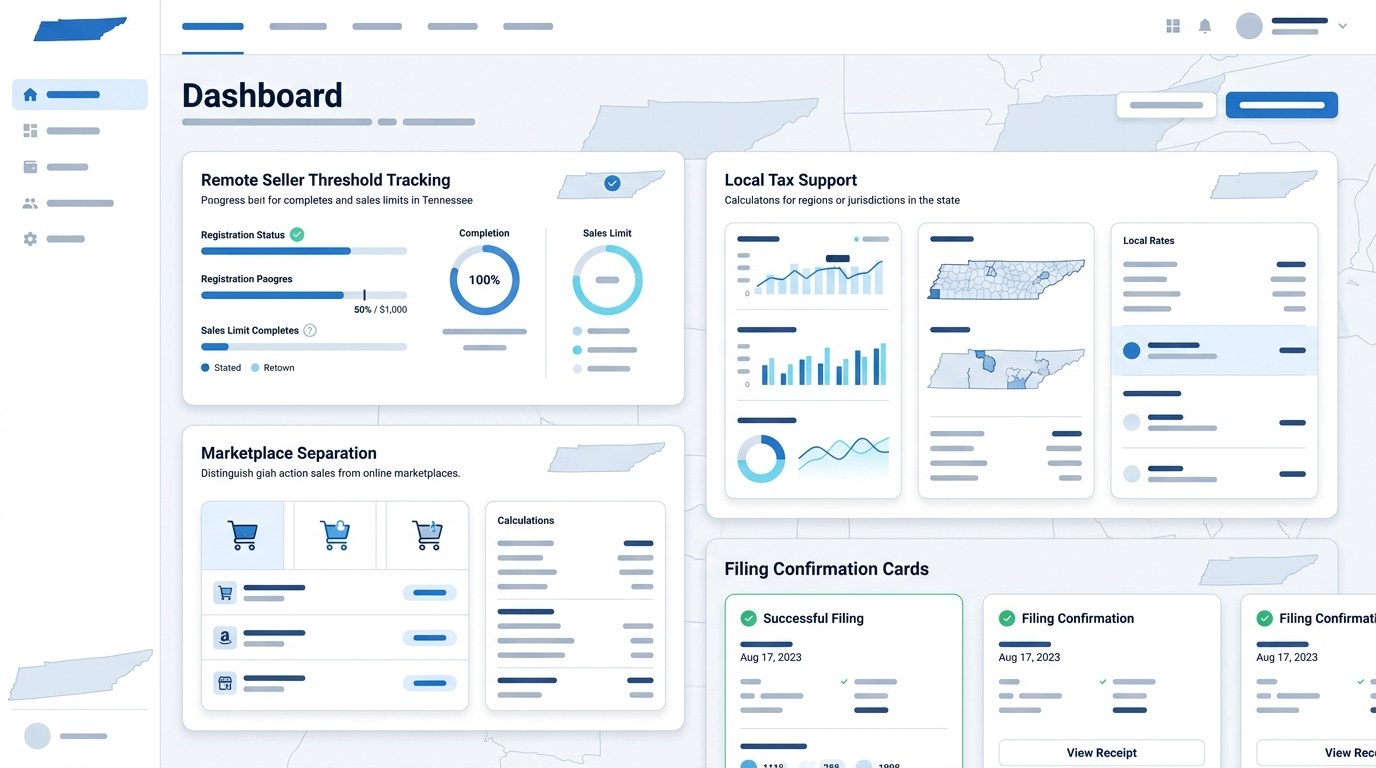
For ecommerce merchants, Tennessee filing packets should preserve direct sales, marketplace sales, tax collected, refunds, customer destination, local tax support, exemption records, and filing confirmation. Tennessee has state and local sales tax, so the filing process should not rely on a single statewide number without supporting detail.
What creates Tennessee sales tax nexus?
- Remote seller threshold: Tennessee sales in excess of $100,000.
- Previous 12 months: Tennessee online-sales guidance describes out-of-state dealers with more than $100,000 in the previous 12 months.
- Physical presence: inventory, employees, events, offices, contractors, or warehouses can create obligations.
- Regular solicitation: regular and systematic solicitation of Tennessee consumers can matter.
- Marketplace sales: marketplace-facilitated sales should be separated from direct merchant-collected sales.
How Tennessee registration fits into the workflow.
Remote sellers that exceed the Tennessee threshold should register with the Tennessee Department of Revenue. Save the registration confirmation, account number, filing frequency, TNTAP owner, payment method, marketplace status, and reviewer assignment.
Because Tennessee sales tax includes local tax considerations, the registration file should also explain how destination and local tax support will be preserved each filing period.
Collection and marketplace treatment.
Tennessee collection depends on product taxability, delivery location, channel, and whether a marketplace collected tax. Direct-channel reports should be reconciled separately from marketplace reports before filing.
- Track Tennessee sales against the $100,000 threshold.
- Separate marketplace-facilitated sales from direct sales.
- Preserve local tax and destination support.
- Save refunds, cancellations, credits, and tax refunds.
- Keep exemption and resale certificate documentation with the packet.
How to prepare a Tennessee sales tax filing packet.
- Export source data: direct orders, marketplace reports, refunds, tax collected, exemptions, and accounting data.
- Confirm nexus: document Tennessee sales exceeding $100,000 and the review period used.
- Map return totals: summarize gross, taxable, exempt, local, and tax-collected amounts.
- Separate channels: identify marketplace-facilitated sales and merchant-collected sales.
- Review filing cadence: confirm the assigned filing frequency and TNTAP workflow.
- Archive proof: save filing confirmation, payment receipt, source exports, and reviewer notes.
Tennessee is also a useful state for testing whether the business has a true recurring workflow. If the same marketplace, refund, or local-tax questions appear every filing period, the packet should be improved rather than rebuilt from memory each month.
When the packet includes those notes, Tennessee becomes easier to review across months and less dependent on the same person remembering how the prior return was handled.
Risk controls for Tennessee.
Tennessee risk often comes from missing the previous-12-month sales review, ignoring local tax support, duplicating marketplace tax, or preparing a return without refund and exemption evidence.
- Was the $100,000 Tennessee sales threshold reviewed?
- Were local tax and destination details preserved?
- Were marketplace and direct sales separated?
- Are refunds and exemptions supported?
- Was filing proof archived with payment confirmation?
Tennessee sales tax FAQ.
What is Tennessee economic nexus?
Tennessee requires remote sellers with no physical presence and Tennessee sales in excess of $100,000 to register and collect tax.
Does Tennessee look at the previous 12 months?
Tennessee online-sales guidance refers to out-of-state dealers with more than $100,000 in sales in the previous 12 months.
Do Tennessee returns need local tax support?
Yes. Tennessee has state and local sales tax, so destination and local tax detail should be preserved in the filing packet.
Can AtomicTax help file Tennessee returns?
Yes. AtomicTax prepares Tennessee filing packets and completes standard sales tax filings for $45 per filing.
Official Tennessee resources to check.
Need help making Tennessee filings repeatable?
AtomicTax prepares reviewable sales tax filing packets from ecommerce reports, separates marketplace and direct-channel activity, and completes standard filings for $45 per filing.