
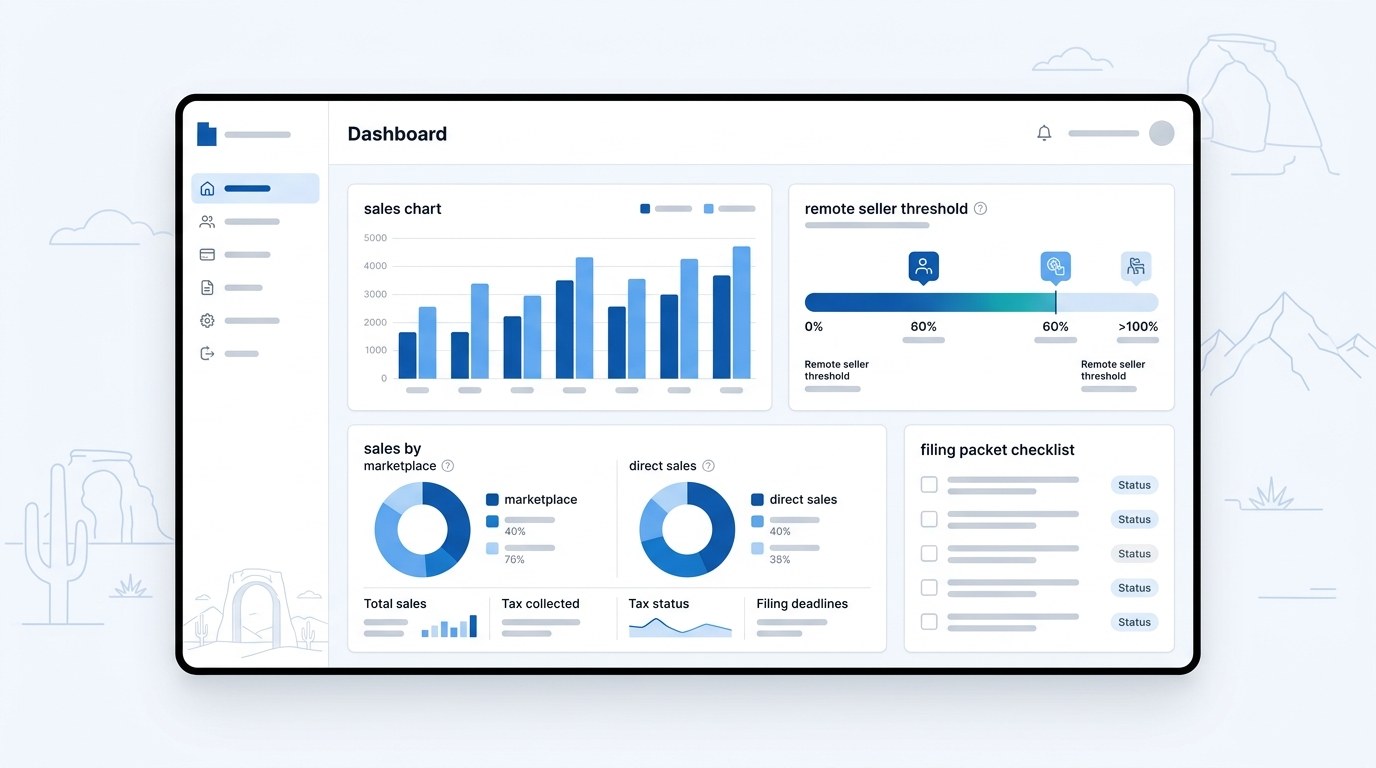
Current Utah remote-seller revenue threshold.
Utah removed the prior 200-transaction threshold.
Remote sellers can register and file through Utah Taxpayer Access Point.
Quick answer.
Utah requires remote sellers to collect and pay Utah sales tax if, in the previous or current calendar year, they receive more than $100,000 in gross revenue from sales of tangible personal property, electronically transferred products, or services for storage, use, or consumption in Utah. Utah notes that before July 1, 2025, a seller could also have nexus if it made 200 or more separate Utah transactions, but that transaction threshold no longer applies after the change.
For ecommerce sellers, Utah filing work should preserve period sales, direct and marketplace channels, destination support, tax collected, refunds, exemptions, and filing confirmation. Utah due-date calendars show monthly and quarterly sales and use tax due dates, and the account's assigned filing frequency should be stored in the packet.
What creates Utah sales tax nexus?
- Economic nexus: more than $100,000 in Utah gross revenue in the previous or current calendar year.
- Prior transaction threshold: Utah states the 200-transaction threshold applied before July 1, 2025, but not after that date.
- Physical presence: inventory, employees, contractors, events, offices, or other operations can create obligations.
- Marketplace sales: marketplace-facilitated sales still need to be separated from direct merchant-collected sales.
- Taxable services and electronic products: review taxability before assuming a product is exempt.
How Utah registration fits into the workflow.
Utah remote sellers can register through Taxpayer Access Point or through Streamlined Sales Tax registration. After registration, save the license, account number, filing frequency, portal owner, payment method, state login process, and reviewer assignment.
The filing packet should also note whether Utah was triggered by revenue threshold, physical presence, voluntary registration, or another reason. That prevents later confusion when the team reviews why Utah is active.
Collection and marketplace treatment.
Utah collection depends on the sale, customer destination, channel, and product taxability. Direct ecommerce sales may require the merchant to collect Utah tax, while marketplace-facilitated sales may be collected by the platform.
For filing review, keep the platform tax settings and the state filing packet aligned. If a storefront changed tax settings mid-period, or if a marketplace began collecting on a new channel, save that note with the period so the return can be understood later.
- Keep direct and marketplace sales separate.
- Preserve destination state and jurisdiction support.
- Track refunds, returns, cancellations, and tax refunds.
- Save resale certificates and exemption support.
- Reconcile tax collected to return totals before filing.
How to prepare a Utah filing packet.
- Export reports: pull orders, refunds, tax, marketplace, exemption, and accounting data for the exact period.
- Validate nexus status: document the $100,000 threshold and why Utah is active.
- Separate channels: split marketplace-facilitated sales from direct taxable sales.
- Summarize Utah totals: gross sales, taxable sales, exempt sales, deductions, tax collected, and adjustments.
- Confirm due date: use the account's assigned monthly, quarterly, or other frequency.
- Archive proof: save filing confirmation, payment receipt, source exports, and reviewer notes.
Risk controls for Utah.
Utah risk often comes from applying the old 200-transaction threshold after July 1, 2025, missing the $100,000 revenue test, duplicating marketplace sales, or filing from reports that do not match the return period.
- Is the current threshold rule documented correctly?
- Are direct and marketplace sales separated?
- Does the packet match the exact filing period?
- Are refunds and exemptions supported?
- Was filing proof saved with payment confirmation?
FAQ.
What is Utah economic nexus in 2026?
Utah requires remote sellers to collect and pay Utah sales tax when Utah gross revenue exceeds $100,000 in the previous or current calendar year.
Does Utah still have a 200-transaction threshold?
No. Utah states that prior to July 1, 2025 the 200-transaction threshold applied, but the current remote-seller page describes the revenue threshold after that change.
Where do Utah remote sellers register?
Remote sellers can register through Utah Taxpayer Access Point or Streamlined Sales Tax registration.
Can AtomicTax help file Utah returns?
Yes. AtomicTax can prepare Utah filing packets and complete standard sales tax filings for $45 per filing.
Sources and references.
Need Utah filings to stay clean?
AtomicTax helps merchants keep Utah threshold tracking, source reports, marketplace sales, and filing proof in one reviewable packet.