
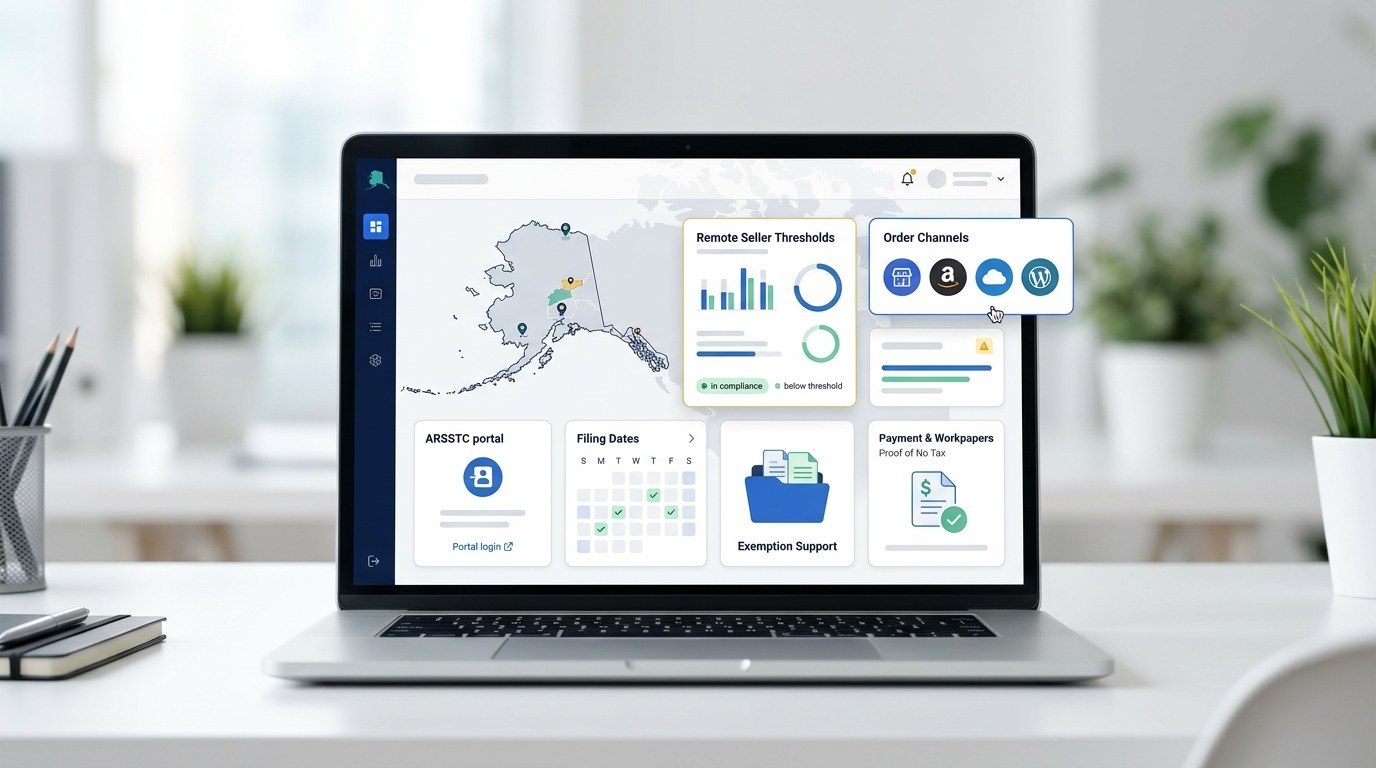
Alaska has no statewide sales and use tax.
ARSSTC remote seller threshold beginning in 2025.
Centralized portal for participating local jurisdictions.
Quick answer for ecommerce sellers.
Alaska is a special case. There is no statewide sales tax, but local jurisdictions may impose sales tax, and many participate in the Alaska Remote Seller Sales Tax Commission. Remote sellers and marketplace facilitators that meet the statewide $100,000 gross sales threshold into Alaska, either last year or this year, must register with ARSSTC if they sell into a taxing member jurisdiction.
The old 200-transaction threshold was removed effective January 1, 2025. Sellers should still track all Alaska gross sales, including sales into non-taxing communities and non-taxable transactions, because the threshold is measured statewide.
Nexus, registration, and seller responsibility.
Alaska local remote-seller compliance depends on sales into communities that adopted the Uniform Alaska Remote Seller Sales Tax Code. A seller that meets the threshold but only delivers into non-taxing communities generally does not need to register until it sells into a taxing member jurisdiction.
- No state tax: Alaska has a 0% state sales and use tax rate.
- Economic threshold: ARSSTC uses $100,000 statewide annual gross sales; the 200-transaction threshold was removed effective January 1, 2025.
- Destination sourcing: remote sales are generally based on the point of delivery into participating local jurisdictions.
- Marketplace activity: marketplace facilitator sales should be separated from direct seller activity for threshold and filing review.
Collection workflow and marketplace handling.
Alaska filing prep is about local jurisdiction mapping. The packet should show which orders went into taxing member jurisdictions, which went into non-taxing communities, which sales were marketplace facilitated, and which were exempt or non-taxable.
- Direct ecommerce sales: preserve order exports, delivery locations, tax calculation support, refunds, and adjustments.
- Marketplace sales: keep Amazon, Walmart, Etsy, eBay, and other facilitator activity separate from direct sales.
- Exempt or non-taxed sales: retain exemption, resale, or no-tax support so the packet explains why tax was not collected.
- Review cadence: assign a preparer, reviewer, due date, and proof owner before the filing window tightens.
How to prepare a filing-ready packet.
ARSSTC provides a centralized way to file for participating jurisdictions, but sales into jurisdictions that have not adopted the code may still need direct local handling. Keep local-rate evidence and jurisdiction membership support with the packet.
- Export exact-period reports: pull orders, refunds, tax, marketplace, exemption, and payout reports.
- Separate channels: split direct ecommerce orders from marketplace-facilitated sales.
- Map the totals: document gross sales, taxable or reportable sales, exempt sales, local taxes or special tax types, deductions, and tax collected.
- Reconcile data: compare checkout tax, payment processor data, accounting entries, and marketplace reports.
- Save proof: retain return confirmation, payment receipt, source exports, preparer notes, and reviewer approval.
Merchant checklist for Alaska local sales tax.
Alaska compliance is less about a single state return and more about proving that local remote sales were reviewed correctly. Before each filing cycle, export Alaska orders by delivery location, identify whether each destination is a participating ARSSTC jurisdiction, confirm whether the order was direct or marketplace facilitated, and document why any order was exempt, non-taxable, or outside a taxing community. Keep a copy of the jurisdiction list or rate lookup used during prep, because local membership and rates can change.
For threshold monitoring, track statewide Alaska gross sales even when orders are delivered to non-taxing communities. That gives the team an early warning before the ARSSTC registration obligation becomes active and avoids the scramble of reconstructing prior-year activity from multiple platforms.
Alaska sales tax FAQ.
Does Alaska have a state sales tax?
No. Alaska has no statewide sales tax, but local jurisdictions may impose sales tax.
What is the Alaska remote seller threshold?
Effective January 1, 2025, ARSSTC uses a $100,000 statewide gross sales threshold and removed the 200-transaction threshold.
Do sales into non-taxing communities count?
ARSSTC says all transactions throughout Alaska count toward the threshold, even if the transactions are in non-taxing communities or are tax exempt.
Where do Alaska remote sellers file?
Remote sellers generally use ARSSTC for participating local jurisdictions.
Can AtomicTax help prepare Alaska local filing packets?
Yes. AtomicTax can help organize direct, marketplace, local jurisdiction, exempt, and non-taxed sales into reviewable filing packets.
Official Alaska resources to check.
Need help keeping sales tax filings repeatable?
AtomicTax prepares filing packets from ecommerce reports, separates marketplace and direct-channel activity, and helps merchants keep every filing period reviewable.