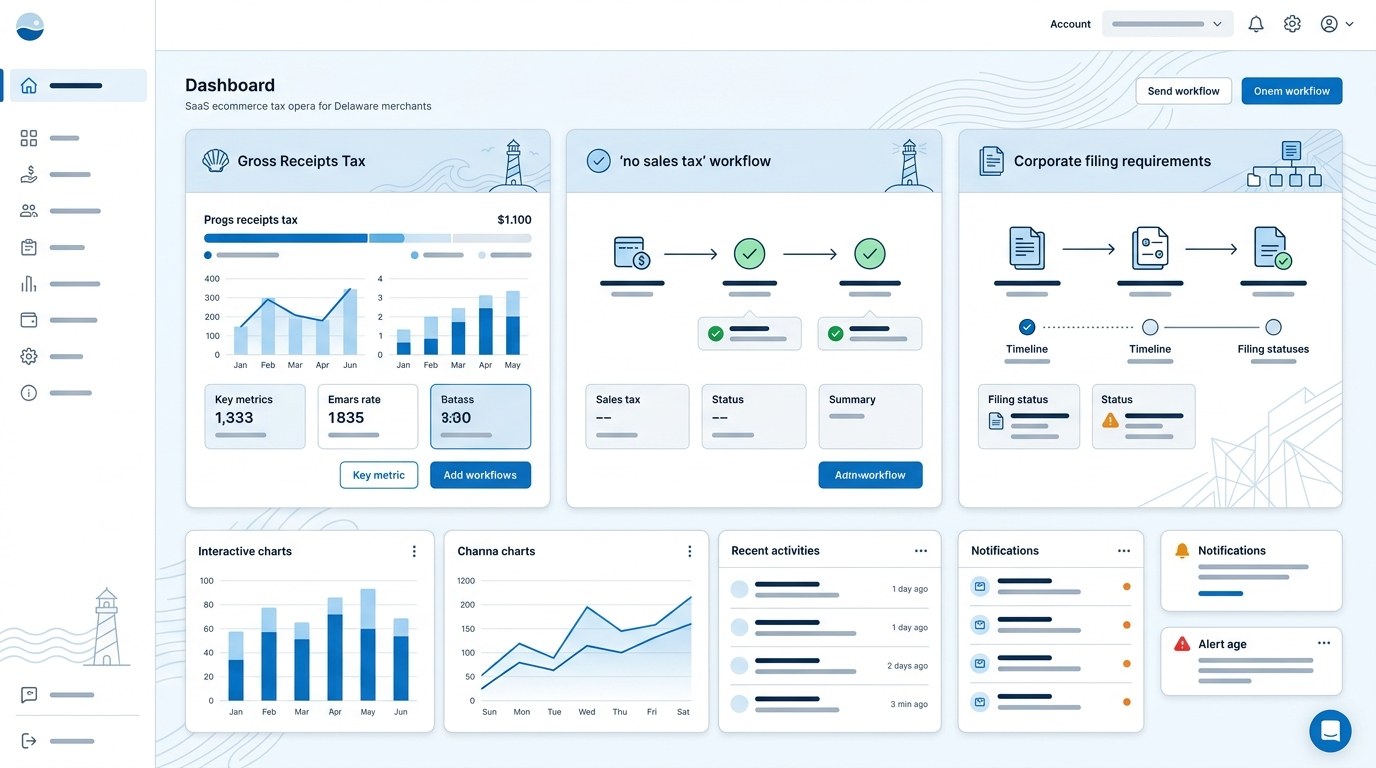
Delaware does not impose state or local sales tax.
Delaware imposes gross receipts tax on many sellers and service providers.
Do not treat Delaware like a normal recurring sales tax return state.
Quick answer for ecommerce sellers.
Delaware does not impose a state or local sales tax. A remote ecommerce seller generally does not collect Delaware sales tax on ordinary sales delivered to Delaware customers. That makes Delaware different from most sales tax states and it should be coded separately in any state-by-state filing calendar.
Delaware does, however, impose gross receipts taxes on many businesses selling goods or providing services in the state. Gross receipts tax is different from sales tax: it is imposed on the seller rather than separately collected from the customer, and the rate and filing cadence can depend on the business activity. Ecommerce operators should not confuse the absence of Delaware sales tax with the absence of all Delaware tax or licensing obligations.
What creates Delaware tax exposure?
Because Delaware does not have sales tax, the familiar economic nexus thresholds used by many sales tax states are not the main issue. The operational question is whether the business has Delaware licensing, gross receipts tax, income tax, withholding, franchise, marketplace, or physical-presence obligations.
- General sales tax: Delaware does not impose state or local sales tax.
- Gross receipts tax: sellers of goods and providers of services in Delaware may owe gross receipts tax depending on activity.
- Business licenses: Delaware business licensing can apply before the sales tax team ever sees a return.
- Physical presence: employees, offices, inventory, or in-state operations can create broader Delaware tax obligations.
- Marketplace reports: marketplace platforms may still show Delaware-destination orders that need to be preserved for revenue reconciliation.
How Delaware registration fits into the workflow.
Do not set up Delaware as a normal sales tax filing account. Instead, document the Delaware position and route any licensing or gross receipts tax question to the right owner. The Delaware Division of Revenue explains that gross receipts tax rates vary by business activity and that separate reporting may be required when a taxpayer earns income from more than one activity type.
For ecommerce teams, the key is visibility. The filing calendar should show Delaware as a reviewed state, not a missing state. That way a manager can see that Delaware was considered and intentionally excluded from standard sales tax filing.
Collection, marketplace sales, and gross receipts tax.
Delaware sales tax is not collected from customers because the state does not impose sales tax. Gross receipts tax works differently: it is generally a tax on the business's receipts from goods sold or services rendered in Delaware, with no deductions for many ordinary costs unless a statute provides otherwise.
- Direct ecommerce orders: do not collect Delaware sales tax, but keep Delaware revenue visible in state reporting.
- Marketplace orders: preserve marketplace sales reports for revenue and channel reconciliation.
- Gross receipts analysis: review whether Delaware-source activity creates a seller-level gross receipts tax issue.
- Licensing: confirm whether the entity has the correct Delaware business license if it is doing business in the state.
- Customer invoices: avoid presenting Delaware gross receipts tax as a customer-collected sales tax unless separately reviewed.
How to prepare a Delaware filing packet.
For standard sales tax operations, a Delaware packet should document the no-sales-tax treatment and identify whether any separate Delaware gross receipts or licensing work belongs outside the standard sales tax queue.
- Export Delaware sales: pull direct orders, marketplace orders, refunds, and revenue by period.
- Confirm sales tax status: document that Delaware has no state or local sales tax.
- Review business activity: note whether sales, services, physical presence, or employees create separate Delaware obligations.
- Route gross receipts questions: send gross receipts tax review to the owner responsible for business taxes.
- Keep marketplace evidence: retain reports showing Delaware-destination orders and taxes, if any, collected by platforms.
- Save approval: keep reviewer notes showing why no Delaware sales tax return was filed.
Risk controls for Delaware.
The main risk is treating Delaware too casually. Delaware has no sales tax, but the state still has business licensing and gross receipts tax rules. A merchant that only thinks in sales tax terms may miss a seller-level obligation that belongs to finance or tax leadership.
Before closing a period, answer these questions:
- Is Delaware marked as a no-sales-tax state in the filing calendar?
- Were Delaware sales kept in the state revenue map?
- Was gross receipts tax reviewed for Delaware-source activity?
- Was business licensing reviewed if the seller is doing business in Delaware?
- Were marketplace and direct sales separated for audit support?
Delaware sales tax FAQ.
Does Delaware have sales tax?
No. Delaware does not impose state or local sales tax.
Does Delaware have gross receipts tax?
Yes. Delaware imposes gross receipts tax on many sellers of goods and providers of services in the state.
Should ecommerce sellers collect Delaware sales tax?
For ordinary retail sales, sellers generally do not collect Delaware sales tax because there is no Delaware sales tax.
How should Delaware be handled in a filing calendar?
Mark Delaware as reviewed and excluded from standard sales tax returns, while separately routing licensing or gross receipts questions when relevant.
Official Delaware resources to check.
Need help making Delaware sales tax work repeatable?
AtomicTax prepares filing-ready sales tax packets from ecommerce reports, separates marketplace and direct-channel activity, and helps merchants keep each filing period reviewable.