
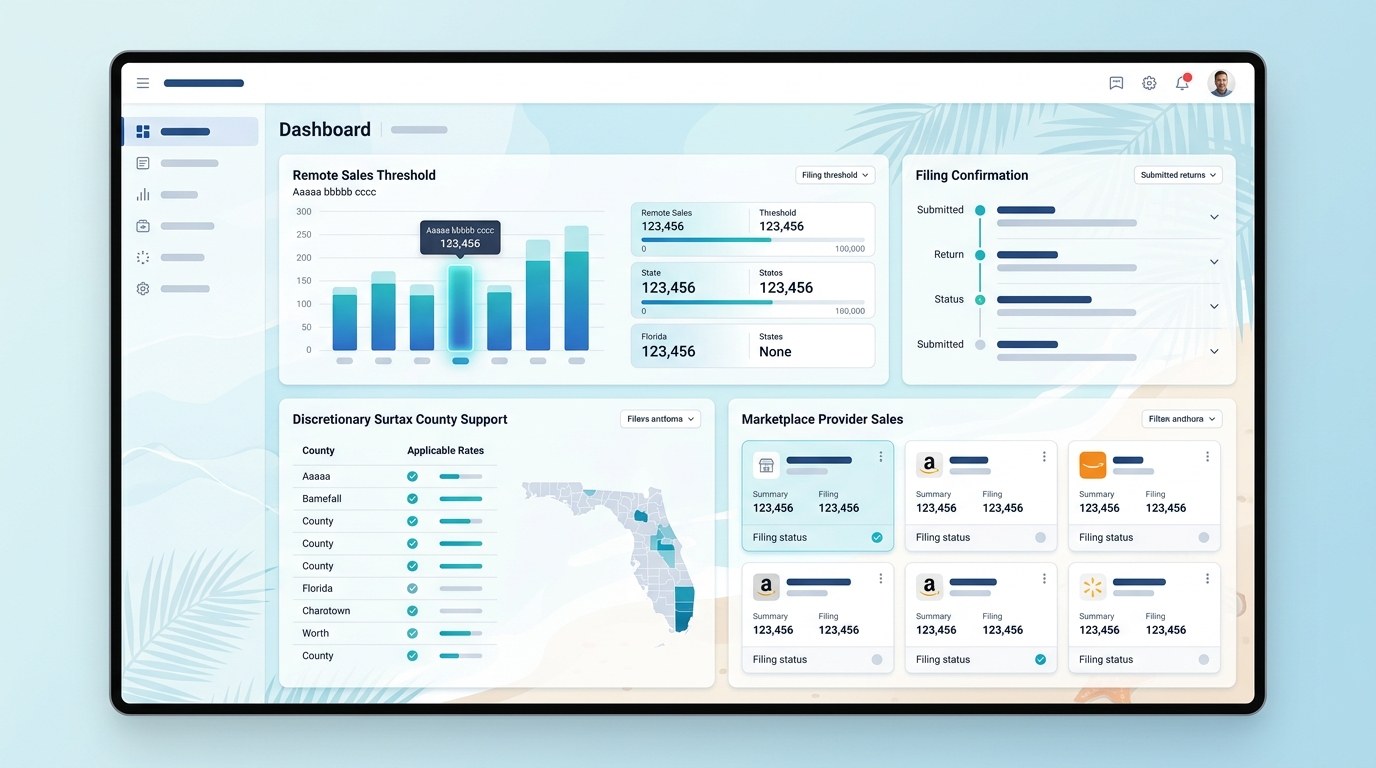
Taxable remote sales threshold over the previous calendar year.
Florida state sales tax rate before discretionary surtax.
County discretionary sales surtax can apply.
Quick answer for ecommerce sellers.
Florida requires businesses making remote sales into the state to collect and electronically remit sales and use tax, including applicable discretionary sales surtax, if they made taxable remote sales in excess of $100,000 over the previous calendar year. The rule has applied since July 1, 2021.
Florida also requires marketplace providers to register, collect, and electronically remit sales and use tax on taxable sales they facilitate for delivery into Florida. For ecommerce sellers, the filing packet should preserve whether sales were direct or marketplace-facilitated, destination county, tax collected, refunds, and proof of electronic filing.
What creates Florida sales tax nexus?
- Remote seller threshold: taxable remote sales into Florida over $100,000 in the previous calendar year.
- Physical presence: inventory, employees, locations, contractors, events, or property can create obligations.
- Marketplace provider role: marketplace providers must register and collect on taxable facilitated sales for delivery into Florida.
- Discretionary surtax: county-level surtax can apply in addition to the 6% state rate.
- Electronic remittance: remote sales tax collection is tied to electronic registration and remittance requirements.
How Florida registration fits into the workflow.
Remote sellers over the threshold should register with the Florida Department of Revenue. Save the certificate, account number, filing frequency, portal owner, payment method, marketplace status, surtax process, and reviewer assignment.
The registration notes should explain whether Florida is active because of taxable remote sales, physical presence, marketplace provider obligations, or another reason. This prevents later reviewers from confusing marketplace-collected sales with merchant-collected tax.
Collection and discretionary surtax support.
Florida collection should preserve county and destination support because discretionary sales surtax varies by county. Direct-channel sales should be separated from marketplace-facilitated sales before return prep.
- Track taxable Florida remote sales against the $100,000 threshold.
- Separate marketplace-facilitated sales from direct sales.
- Preserve county/destination and discretionary surtax support.
- Track refunds, credits, tax refunds, and cancellations.
- Save exemption and resale certificate evidence.
How to prepare a Florida sales tax filing packet.
- Export exact-period reports: direct orders, marketplace reports, refunds, tax collected, exemptions, and accounting data.
- Confirm threshold status: document prior-calendar-year taxable remote sales.
- Map surtax: preserve county-level discretionary surtax support.
- Separate channels: avoid duplicating marketplace-provider sales tax.
- File electronically: submit and pay through the Florida Department of Revenue process.
- Archive proof: save return confirmation, payment receipt, source reports, and reviewer notes.
Florida is also sensitive to county-level surtax support, so the filing packet should retain the customer destination used for tax calculation. If the store only exports a state total, request a more detailed report before filing.
For remote sellers, keep the prior-calendar-year threshold review with the current filing packet. That lets the reviewer see both why Florida is active and how the current return was prepared.
When Florida sales include multiple counties, save the destination report before filing. That one backup file can prevent a simple surtax question from turning into a full reconstruction of the period.
Risk controls for Florida.
Florida risk often comes from overlooking discretionary surtax, using all gross sales instead of taxable remote sales for threshold review, duplicating marketplace sales, or filing without proof of county-level support.
- Was the prior-year $100,000 taxable remote-sales test reviewed?
- Were marketplace-provider sales separated?
- Does the packet preserve county surtax support?
- Are refunds and exemptions documented?
- Was electronic filing and payment proof archived?
Florida sales tax FAQ.
What is Florida economic nexus?
Florida requires remote sellers to collect and remit when taxable remote sales into Florida exceed $100,000 over the previous calendar year.
Does Florida have marketplace provider rules?
Yes. Marketplace providers must register, collect, and electronically remit tax on taxable sales they facilitate for delivery into Florida.
What is Florida’s state sales tax rate?
Florida’s state sales tax rate is 6%, and discretionary county surtax may also apply.
Can AtomicTax help file Florida returns?
Yes. AtomicTax prepares Florida filing packets and completes standard sales tax filings for $45 per filing.
Official Florida resources to check.
Need help making Florida filings repeatable?
AtomicTax prepares reviewable sales tax filing packets from ecommerce reports, separates marketplace and direct-channel activity, and completes standard filings for $45 per filing.