
Economic nexus threshold for taxable gross receipts in the previous calendar year.
New Mexico imposes gross receipts tax on the business, not a traditional sales tax.
New Mexico recommends electronic filing through Taxpayer Access Point.
Quick answer for ecommerce sellers.
If you sell into New Mexico, the key question is whether your activity creates gross receipts tax obligations. New Mexico says businesses without physical presence, including marketplace providers and sellers, are subject to GRT if they have at least $100,000 of taxable gross receipts in the previous calendar year from sales, leases, licenses, and services sourced to New Mexico.
Unlike many states, New Mexico's tax is imposed on the business. It is common to pass GRT on to the purchaser, and if passed on, it must be separately stated on the invoice. Filing prep should preserve direct sales, marketplace sales, deductions, exemptions, destination/location codes, tax passed through, and TAP confirmation.
What creates New Mexico gross receipts tax nexus?
New Mexico nexus can come from physical presence or from engaging in business in the state. The state defines engaging in business broadly as carrying on activity for direct or indirect benefit, and economic nexus applies to businesses lacking physical presence once the taxable gross receipts threshold is met.
- Physical presence: employees, property, inventory, contractors, offices, or activities in New Mexico can create obligations.
- Economic nexus: monitor at least $100,000 of taxable gross receipts sourced to New Mexico in the previous calendar year.
- Marketplace providers and sellers: marketplace activity can affect who reports and pays, but merchants still need channel-level records.
- Services: New Mexico GRT can apply to services, so ecommerce-adjacent and SaaS-style offers need careful taxability review.
How New Mexico registration fits into the workflow.
Before registration, gather the legal entity name, EIN, responsible party, business address, sales start date, direct ecommerce channels, marketplaces, product and service categories, expected New Mexico gross receipts, and payment owner. New Mexico businesses should also understand whether they need non-taxable transaction certificate support for deductions.
After registration, save TAP access, account details, filing frequency, location-code process, payment method, marketplace status, deduction support process, and reviewer assignment in the compliance workspace.
Rates, location codes, and marketplace sales.
New Mexico gross receipts tax rates vary across the state because total rates combine state, county, and municipal components by location. This makes address and location-code discipline central to a clean filing packet.
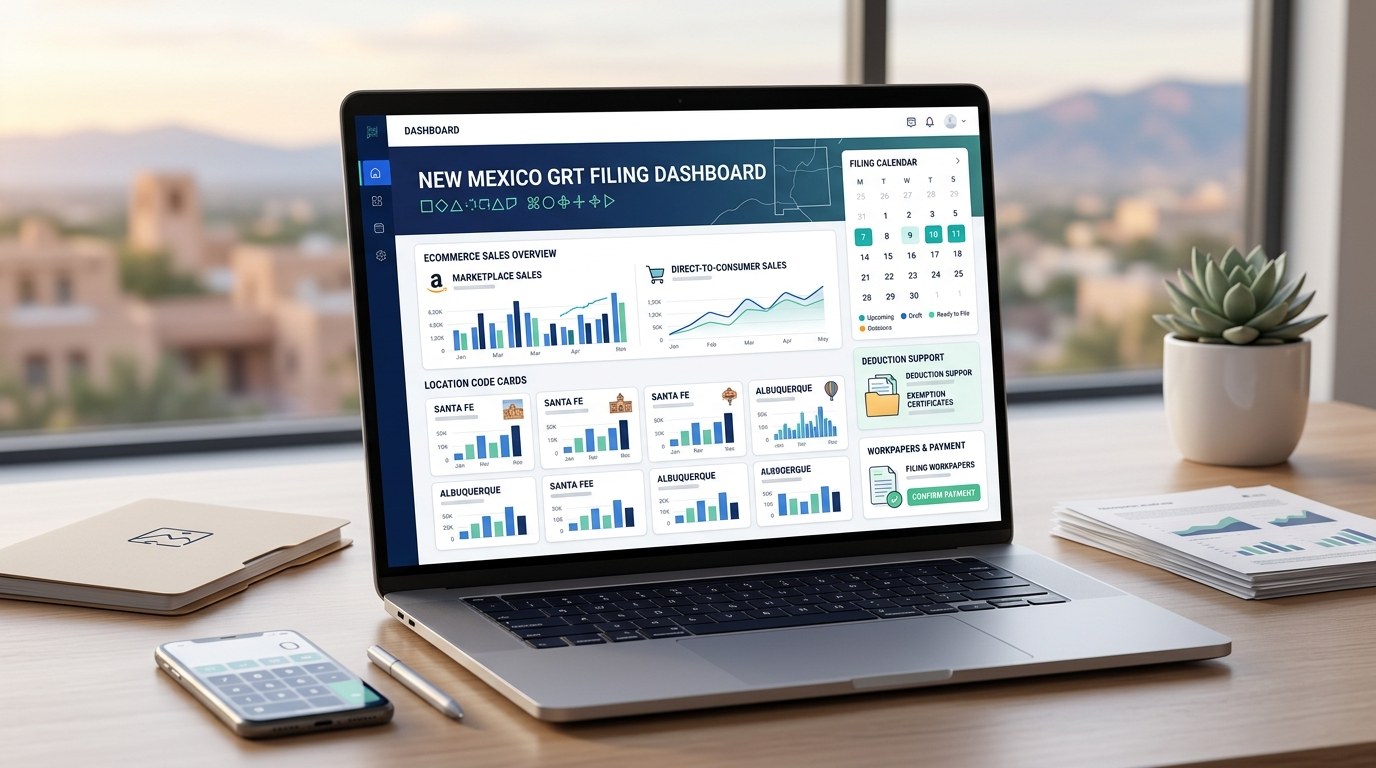
- Direct ecommerce sales: orders where the merchant reports New Mexico gross receipts directly.
- Marketplace sales: Amazon, Walmart, Etsy, eBay, and other marketplace-facilitated sales should be separated before filing review.
- Location codes: preserve delivery location, sourcing, rate, and location-code support for each New Mexico transaction.
- Deductions and exemptions: document non-taxable transaction certificates and other deduction support before the return is prepared.
- Refunds and adjustments: returns, credits, and tax passed through should tie to the filing period.
How to prepare a New Mexico GRT filing packet.
New Mexico recommends filing electronically through Taxpayer Access Point. A filing-ready packet should explain gross receipts, deductions, taxable receipts, marketplace handling, location codes, tax passed through, and payment proof.
- Export exact-period reports: pull orders, refunds, tax/GRT, marketplace, deduction, exemption, and payout reports.
- Separate channels: split direct ecommerce activity from marketplace-facilitated activity.
- Map New Mexico totals: document gross receipts, taxable gross receipts, deductions, location codes, tax passed through, and adjustments.
- Reconcile data: compare checkout tax, payment processor data, accounting entries, and marketplace reports.
- Review deductions: confirm NTTCs or other support are saved before claiming deductions.
- Save proof: retain the TAP confirmation, payment receipt, source exports, preparer notes, and reviewer approval.
What happens if New Mexico filings are late or unsupported?
Late filing, late payment, unsupported deductions, incorrect location codes, marketplace duplication, and weak records can create notices, penalties, interest, amended returns, or refund work. The most useful habit is to keep the return traceable back to source exports and deduction records.
Before filing, review this checklist:
- Does the filing period match every source export?
- Are direct and marketplace gross receipts separated?
- Are location codes and rates reviewable?
- Are deductions supported by certificates or documentation?
- Do refunds and tax passed through reconcile to accounting?
- Was TAP confirmation and payment proof saved?
New Mexico GRT FAQ.
What is New Mexico economic nexus?
Businesses without physical presence are subject to GRT if they have at least $100,000 of taxable gross receipts sourced to New Mexico in the previous calendar year.
Is New Mexico sales tax the same as gross receipts tax?
No. New Mexico uses gross receipts tax, which is imposed on the business. It is commonly passed on to customers and separately stated on invoices.
Where do New Mexico sellers file?
New Mexico recommends filing electronically through Taxpayer Access Point, or TAP.
Do marketplace sales need to be separated?
Yes. Marketplace-facilitated sales should be separated from direct ecommerce activity so the filing packet does not duplicate activity or hide threshold data.
Can AtomicTax help file New Mexico returns?
Yes. AtomicTax helps ecommerce merchants prepare filing-ready packets and complete standard sales tax and gross receipts filings for $45 per filing.
Official New Mexico resources to check.
Need help making New Mexico filings repeatable?
AtomicTax prepares filing packets from ecommerce reports, separates marketplace and direct-channel activity, and helps merchants keep every filing period reviewable.