South Carolina statewide Sales and Use Tax rate before local taxes.
Remote sellers exceed economic nexus when gross revenue passes $100,000.
SCDOR free online portal for registration, filing, and payment.
Quick answer for ecommerce sellers.
Remote sellers with economic nexus in South Carolina must obtain a Retail License and collect, file, and pay Sales Tax to SCDOR. South Carolina defines a remote seller with economic nexus as an out-of-state retailer with no physical presence whose gross revenue exceeds $100,000 in the previous or current calendar year from sales of tangible personal property, electronically transferred products, or services delivered into South Carolina.
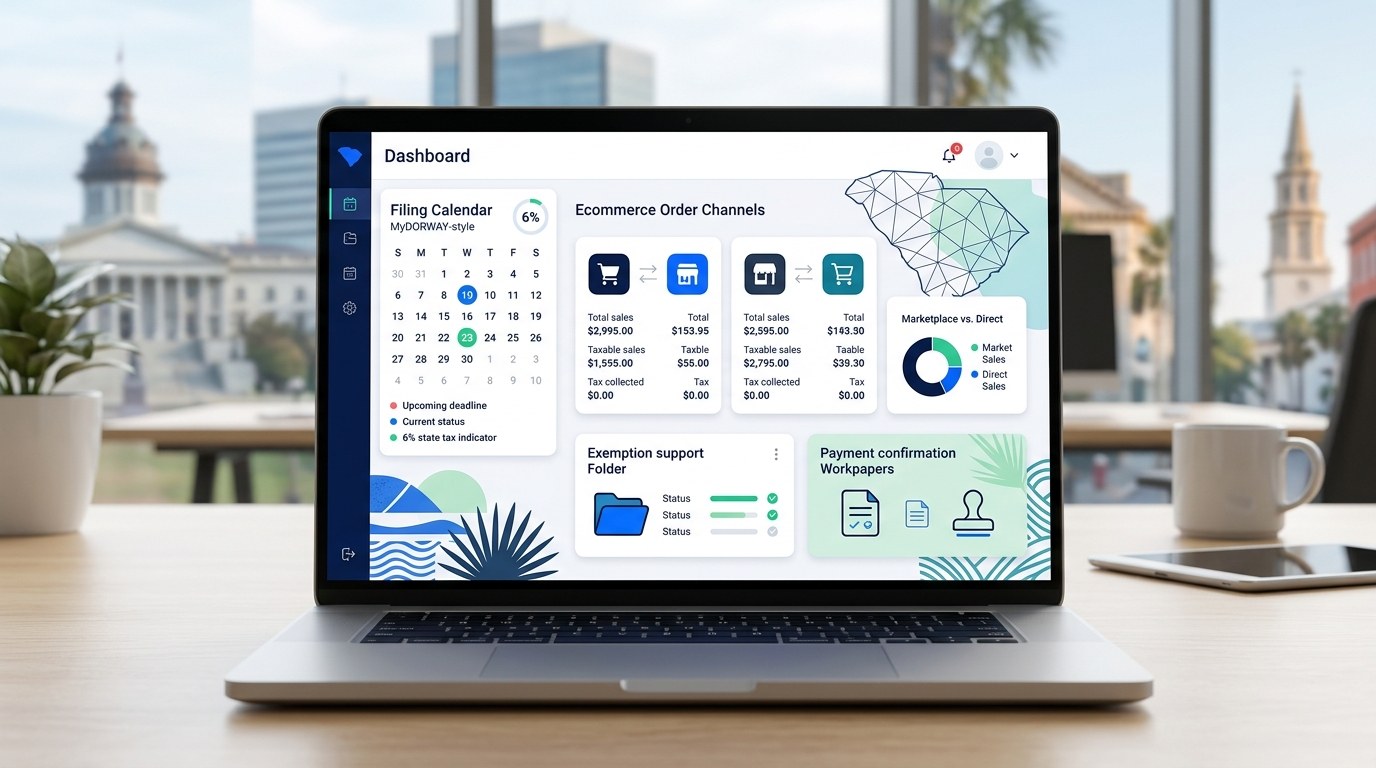
The statewide Sales and Use Tax rate is 6%, and counties or municipalities may impose additional local taxes. Ecommerce sellers should prepare packets that preserve direct sales, marketplace sales, local-tax support, exemption records, zero-return periods, tax collected, and MyDORWAY confirmation.
What creates South Carolina sales tax nexus?
South Carolina nexus can come from physical presence, economic nexus, agents, inventory, offices, warehouses, or remote seller activity.
- Physical presence: an office, distribution house, sales house, warehouse, place of business, subsidiary, or agent operating in South Carolina can create nexus.
- Economic nexus: monitor whether gross revenue exceeds $100,000 in the previous or current calendar year.
- Marketplace sales: marketplace-facilitated sales should stay separate from direct sales so the filing packet does not duplicate tax already handled by a facilitator.
- Local taxes: county-wide and local taxes can affect the combined rate, so destination detail matters.
How South Carolina registration fits into the workflow.
Remote sellers with nexus must apply for a Retail License through MyDORWAY. The Retail License has a one-time $50 fee for each retail location, and remote sellers that close and later reopen the license may need to pay again.
After registration, save the retail license, MyDORWAY access owner, filing frequency, payment method, local-rate process, marketplace status, and reviewer assignment in the compliance workspace.
Collection, local taxes, and marketplace sales.
South Carolina imposes a 6% statewide Sales and Use Tax, and most local taxes administered by SCDOR are 1%, although total local rates vary by county or city.
- Direct ecommerce sales: orders where the merchant is seller of record and may need to collect South Carolina tax.
- Marketplace sales: Amazon, Walmart, Etsy, eBay, and other marketplace-facilitated orders should be separated before return prep.
- Local taxes: preserve delivery address, jurisdiction, rate lookup support, and platform tax calculation evidence.
- Exempt sales: resale and exemption certificate support should be saved with the period workpapers.
- Refunds and adjustments: returns, credits, cancellations, and tax refunds should tie to the filing period.
How to prepare a South Carolina sales tax filing packet.
South Carolina Sales and Use Tax returns are due by the 20th of the month following the end of the month in which sales occurred. A return is due for each open filing period, including zero-sales or zero-tax-due periods.
- Export exact-period reports: pull orders, refunds, tax, marketplace, exemption, and payout reports.
- Separate channels: split direct ecommerce sales from marketplace-facilitated sales.
- Map South Carolina totals: document gross sales, taxable sales, exempt sales, local taxes, deductions, and tax collected.
- Reconcile data: compare checkout tax, payment processor data, accounting entries, and marketplace reports.
- Review filing cadence: confirm the account's monthly, quarterly, annual, or assigned filing frequency.
- Save proof: retain the portal confirmation, payment receipt, source exports, preparer notes, and reviewer approval.
What happens if South Carolina filings are late or unsupported?
Late returns, late payment, unsupported exemptions, local-rate mistakes, marketplace duplication, and missed zero returns can create notices, penalties, interest, and amended return work. Timely filing may also affect available vendor discounts.
Before filing, review this checklist:
- Does the filing period match every source export?
- Are direct and marketplace sales separated?
- Are local taxes and delivery locations reviewable?
- Are exemption and resale records saved?
- Do refunds and tax collected reconcile to accounting?
- Was filing confirmation and payment proof saved?
South Carolina sales tax FAQ.
What is South Carolina economic nexus?
Remote sellers have economic nexus when gross revenue exceeds $100,000 in the previous or current calendar year from sales delivered into South Carolina.
What is the South Carolina sales tax rate?
The statewide rate is 6%, with additional local taxes in many counties and some municipalities.
Where do South Carolina sellers file?
Sellers can register, file, and pay through MyDORWAY.
Do zero returns need to be filed?
Yes. SCDOR says returns are due for each open filing period, including zero-sales or zero-tax-due periods.
Can AtomicTax help file South Carolina returns?
Yes. AtomicTax prepares filing-ready packets and completes standard sales tax filings for $45 per filing.
Official South Carolina resources to check.
Need help making South Carolina filings repeatable?
AtomicTax prepares sales tax filing packets from ecommerce reports, separates marketplace and direct-channel activity, and helps merchants keep every filing period reviewable.