
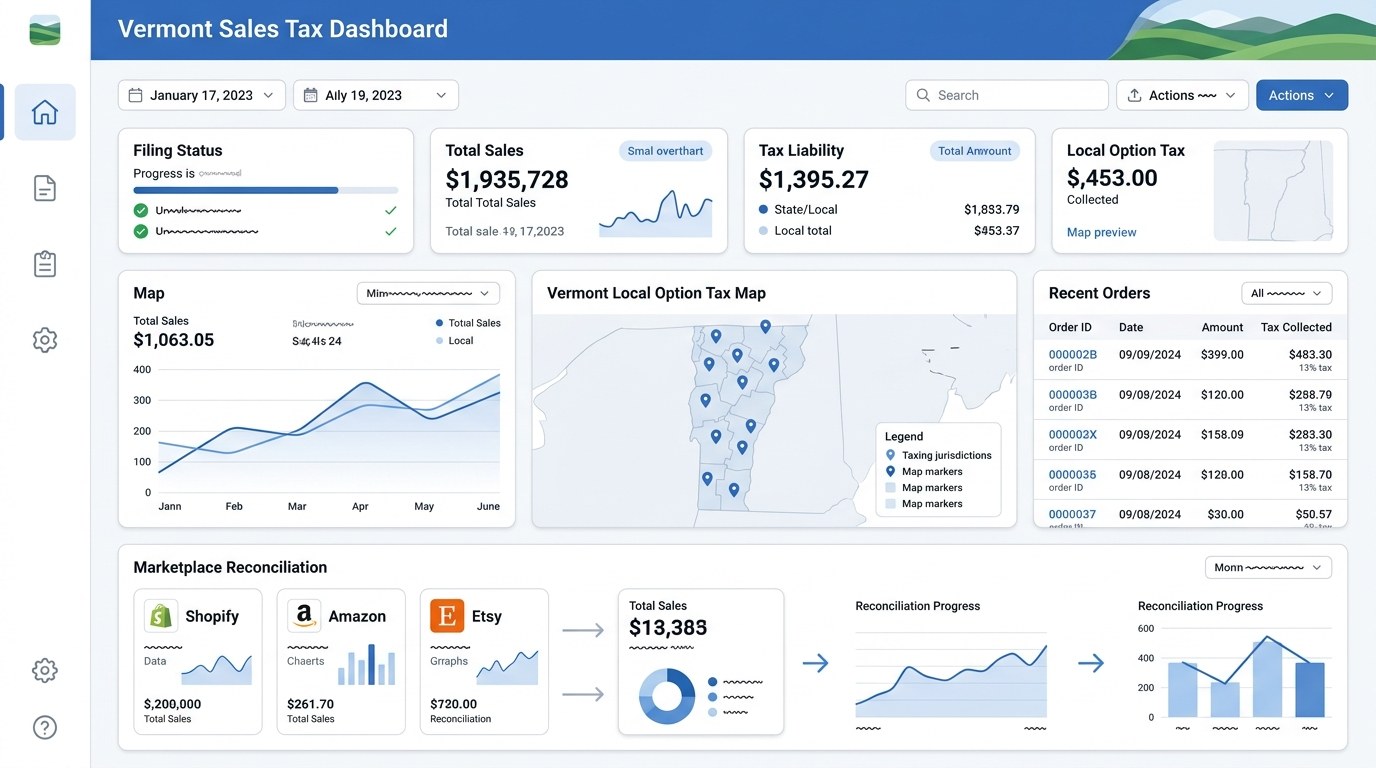
Vermont state sales and use tax rate.
Remote seller threshold based on sales or individual transactions.
Some municipalities add a 1% local option sales tax.
Quick answer for ecommerce sellers.
Vermont imposes a 6% sales and use tax on taxable retail sales, and some municipalities impose an additional 1% local option sales tax. Remote sellers can create Vermont sales tax obligations when sales delivered into Vermont reach at least $100,000 or 200 individual sales transactions during the relevant preceding twelve-month period.
For ecommerce merchants, Vermont filing work should separate direct sales from marketplace-facilitated sales, confirm taxable and exempt amounts, identify local option destinations, and preserve the support used to calculate the return. Vermont is a Streamlined Sales Tax member state, but the filing packet still needs clean source exports and a review trail.
What creates Vermont sales tax nexus?
Vermont nexus can come from physical presence, remote-seller activity, marketplace facilitation, or in-state operations. The remote seller rule generally looks at sales from outside Vermont to Vermont destinations of at least $100,000 or at least 200 individual sales transactions during the twelve-month lookback period.
- Physical presence: inventory, employees, contractors, offices, events, or other operations in Vermont can create a registration obligation.
- Economic nexus: remote sellers should monitor Vermont-destination sales and transaction counts.
- Marketplace facilitator rules: marketplace facilitators can have obligations, and marketplace sellers should separate platform sales from direct sales.
- Local option towns: a 1% local option sales tax can apply on taxable destination sales in participating municipalities.
- Digital and taxable items: product taxability should be reviewed before relying on platform defaults.
How Vermont registration fits into the workflow.
Once a seller determines it has Vermont nexus, the next step is registration for sales and use tax. The filing team should store the Vermont account information, filing frequency, portal credentials owner, local option rate process, marketplace status, and exemption certificate workflow in one place.
Because Vermont can involve both state and local option tax, the registration file should also explain how the team determines whether a delivery address is inside a local option municipality. That note is useful later when notices, amendments, or customer tax questions come up.
Collection, marketplace sales, and local option tax.
Vermont collection should start with the taxable product, customer location, and sales channel. Direct ecommerce sales may require the merchant to collect Vermont tax, while marketplace-facilitated sales may be collected by the marketplace depending on the platform and transaction.
- Direct sales: preserve order-level destination, taxable amount, tax collected, refunds, discounts, and shipping treatment.
- Marketplace sales: separate marketplace-facilitated sales from merchant-collected direct sales to avoid duplicate reporting.
- Local option sales tax: identify whether taxable sales are delivered to a local option municipality and apply the additional local rate when required.
- Exemptions: keep exemption certificates and exempt-sale support with the period packet.
- Adjustments: returns, refunds, tax credits, and cancelled orders should tie to the period being filed.
How to prepare a Vermont sales tax filing packet.
Vermont returns can be annual, quarterly, or monthly depending on liability and account assignment. A good filing packet explains the return rather than only saving the confirmation screen.
- Export source reports: pull exact-period orders, refunds, marketplace reports, tax collected, exemptions, and payout data.
- Separate channels: split direct sales, marketplace sales, wholesale, exempt, and non-Vermont orders.
- Map destinations: identify Vermont sales by delivery address and local option municipality.
- Reconcile tax: compare checkout tax, marketplace tax, accounting revenue, payment processor deposits, and return totals.
- Review frequency: confirm the Vermont filing cadence and due date before submitting.
- Save proof: retain source exports, tax calculations, reviewer notes, portal confirmation, and payment receipt.
Risk controls for Vermont.
Vermont risk usually comes from missing the remote-seller threshold, ignoring local option tax, over-reporting marketplace sales, or filing from a platform summary that cannot be tied back to order detail. A period packet should let a reviewer rebuild the return if a notice arrives months later.
Before filing, review this checklist:
- Does the filing period match all exports?
- Were marketplace-facilitated sales separated from direct sales?
- Were local option destinations reviewed?
- Are exempt sales supported by certificates or clear notes?
- Do refunds and tax collected reconcile to the return?
- Was the portal confirmation and payment proof saved?
Vermont sales tax FAQ.
What is the Vermont sales tax rate?
Vermont imposes a 6% state sales and use tax, and some municipalities impose a 1% local option sales tax.
What is Vermont economic nexus?
Remote sellers can trigger Vermont nexus with at least $100,000 in Vermont-destination sales or 200 individual sales transactions during the relevant twelve-month period.
When are Vermont sales tax returns due?
Vermont law provides annual, quarterly, and monthly filing rules based on liability; many returns are due on the 25th day after the period, with February monthly returns noted separately in statute.
Do marketplace sales need to be separated?
Yes. Marketplace-facilitated sales should be separated from direct merchant-collected sales before filing.
Official Vermont resources to check.
Need help making Vermont sales tax work repeatable?
AtomicTax prepares filing-ready sales tax packets from ecommerce reports, separates marketplace and direct-channel activity, and helps merchants keep each filing period reviewable.