
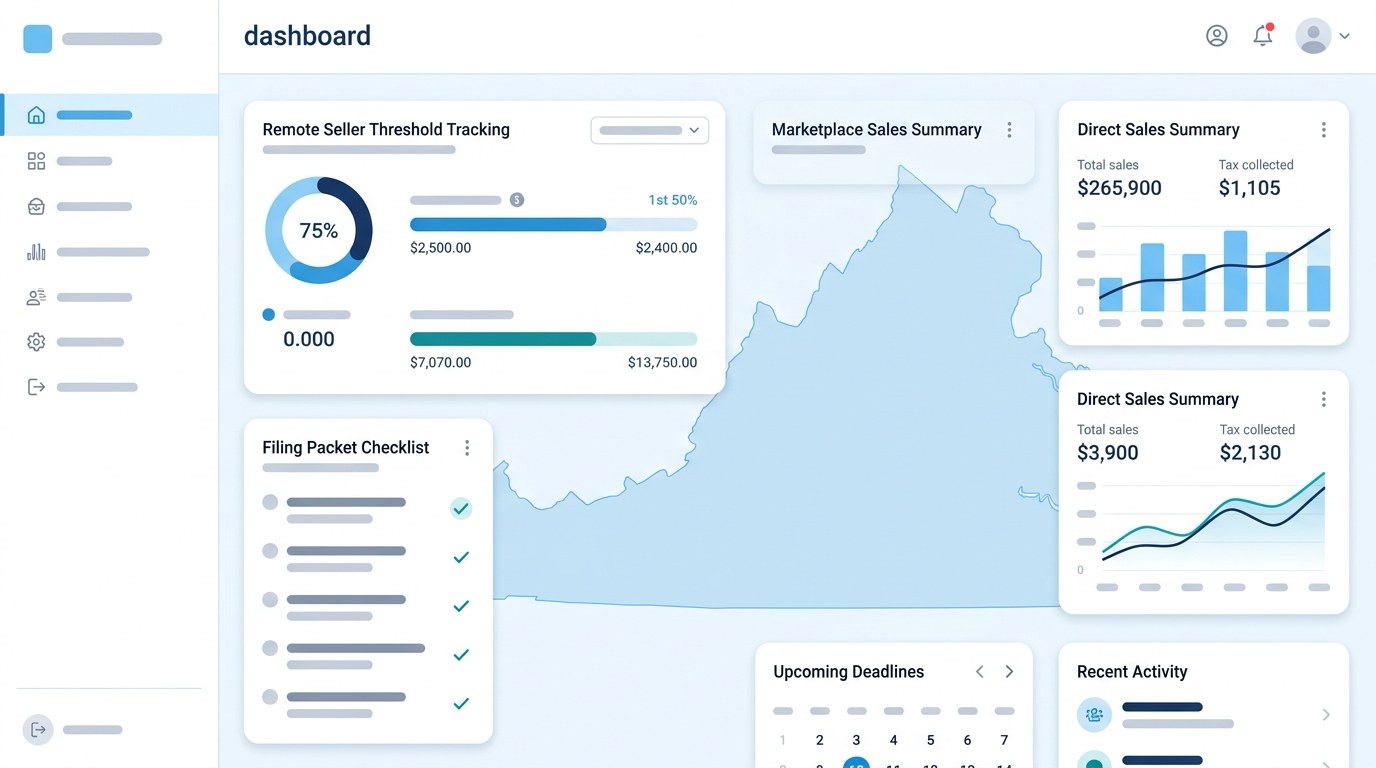
Virginia remote seller economic nexus threshold.
Returns are generally due on the 20th after the filing period.
Virginia sales tax must be filed and paid electronically.
Quick answer for ecommerce sellers.
Virginia requires remote sellers and marketplace facilitators to register, collect, and remit sales and use tax when they exceed $100,000 in annual gross retail sales or 200 or more transactions to Virginia customers. The rule can apply even without physical presence in Virginia.
Virginia sales tax rates vary by locality and transaction type. The filing team should preserve delivery location, direct versus marketplace sales, exempt sales, tax collected, refunds, and portal proof. Virginia also requires electronic filing and payment, and returns are generally due on the 20th day of the month following the close of the filing period.
What creates Virginia sales tax nexus?
Virginia nexus can come from physical presence, remote-seller economic activity, marketplace facilitation, or a mix of roles. A business may be a remote seller, a marketplace seller, a marketplace facilitator, or more than one depending on how it sells.
- Physical presence: employees, inventory, warehouses, events, offices, or contractors in Virginia can create a registration obligation.
- Economic nexus: remote sellers meet the threshold with more than $100,000 in annual gross retail sales or 200 or more transactions to Virginia customers.
- Marketplace facilitators: facilitators that meet the threshold must generally register and collect for facilitated sales.
- Marketplace sellers: sellers that only sell through a collecting marketplace may not need to register for those platform sales, but direct Virginia sales can create obligations.
- Local and regional rates: the correct rate can depend on where the merchandise is received and applicable local or regional taxes.
How Virginia registration fits into the workflow.
Virginia explains that in-state dealers and out-of-state dealers are registered differently. Remote sellers generally register as out-of-state dealers, and the account type matters because it affects how the filing account is administered.
After registration, save the account number, certificate, filing frequency, portal owner, payment method, marketplace status, and reviewer assignment. If the business is also a marketplace facilitator, the registration profile should reflect that role so tax responsibilities are not misclassified.
Collection, marketplace sales, and destination support.
Virginia sales tax collection should be tied to customer location, product taxability, sales channel, and whether a marketplace collected on the seller's behalf. Direct ecommerce orders need enough detail to support the rate used and the amount remitted.
- Direct sales: preserve destination address, taxable amount, tax charged, discounts, shipping treatment, and refund activity.
- Marketplace sales: separate marketplace-facilitated sales from direct-channel sales before preparing the return.
- Facilitator role: marketplace facilitators must maintain separate records for facilitated and direct sales.
- Exemptions: resale certificates and exempt sales should be saved with the period workpapers.
- Rate support: local and regional taxes make address-level support important for later review.
How to prepare a Virginia sales tax filing packet.
Virginia determines filing frequency based on liability, and sales tax returns are filed electronically. Starting with the April 2025 filing period, Virginia states that all sales tax filers use Form ST-1, replacing several prior sales tax forms for previous filing periods.
- Export exact-period data: pull direct orders, refunds, marketplace reports, exemptions, tax collected, and accounting revenue.
- Separate sales channels: identify direct merchant-collected sales, marketplace-facilitated sales, exempt sales, and non-Virginia orders.
- Confirm destination totals: summarize Virginia sales by address, locality, taxable amount, and tax collected.
- Reconcile: compare checkout tax, marketplace tax, payment processor deposits, and accounting entries to return totals.
- File electronically: submit through the assigned Virginia filing process and pay electronically.
- Save proof: keep exports, calculation notes, reviewer approval, confirmation, and payment receipt.
Risk controls for Virginia.
Virginia filing risk often shows up as missed nexus, missing local-rate support, duplicate reporting of marketplace sales, unsupported exemptions, or returns prepared from a summary report that cannot be tied back to individual orders.
Before filing, review this checklist:
- Did the seller cross the $100,000 or 200-transaction threshold?
- Were direct and marketplace-facilitated sales separated?
- Does the return use the right filing period and frequency?
- Can taxable, exempt, and refunded sales be traced to source exports?
- Was local-rate and destination support saved?
- Were the electronic filing confirmation and payment receipt archived?
Virginia sales tax FAQ.
What is Virginia economic nexus?
A remote seller or marketplace facilitator has economic nexus if it has more than $100,000 in annual gross retail sales or 200 or more transactions to Virginia customers.
When are Virginia sales tax returns due?
Virginia states that returns are due on the 20th day of the month following the close of the filing period.
Does Virginia require electronic filing?
Yes. Virginia sales tax must be filed and paid electronically.
Do marketplace-only sellers need to register in Virginia?
If all Virginia sales are through a collecting marketplace facilitator, the seller generally does not need to register for those marketplace sales, but direct Virginia sales can create a registration obligation.
Official Virginia resources to check.
Need help making Virginia sales tax work repeatable?
AtomicTax prepares filing-ready sales tax packets from ecommerce reports, separates marketplace and direct-channel activity, and helps merchants keep each filing period reviewable.