
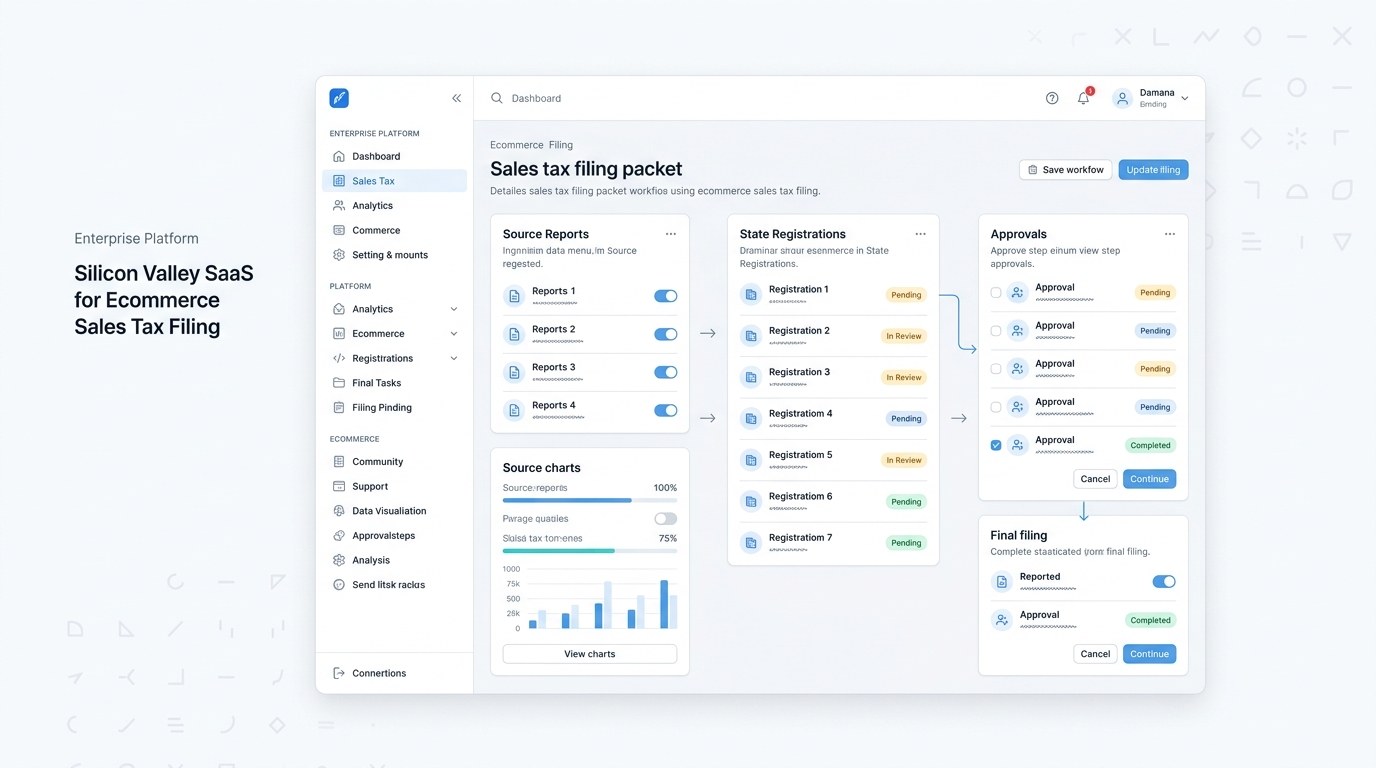
Built around merchant filing packets, state workflows, and approvals.
Standard sales tax filings are priced at $45 per filing.
Useful when a team wants help filing, not a large enterprise rollout.
Quick answer.
If your company needs enterprise tax calculation, exemption certificate management, consumer use tax, international tax coverage, APIs, and a broad implementation program, Avalara may be the more appropriate category of platform. Avalara describes AvaTax as a system for real-time tax determination across many jurisdictions and positions its sales and use tax suite around calculation, exemptions, returns, integrations, and enterprise compliance operations.
AtomicTax is different on purpose. It is built for merchants that already have sales data in Shopify, marketplaces, Stripe, WooCommerce, BigCommerce, accounting exports, CSV files, Excel workbooks, or other source reports and need a cleaner path to state registration, filing packets, review, and recurring returns. The buying question is not which brand is bigger. It is how much tax platform your business actually needs.
Where AtomicTax and Avalara differ.
Avalara is best understood as a broad compliance platform. AtomicTax is best understood as a focused operating workflow for sales tax filing. That distinction matters for smaller and mid-market sellers because the real bottleneck is often not tax calculation at checkout. It is knowing which states are active, whether marketplace sales were separated, whether a registration is complete, and whether a filing packet can be reviewed before money leaves the account.
- Platform breadth: Avalara covers a wider set of tax compliance needs; AtomicTax keeps the workflow narrower.
- Implementation weight: Avalara-style projects can involve integrations, configuration, and ongoing platform administration; AtomicTax can start from exports and connected source reports.
- Filing focus: AtomicTax is built around the filing packet: source reports, adjustments, reviewer notes, return proof, and payment confirmation.
- Merchant operations: AtomicTax is useful when sales tax is an operations problem shared by finance, founders, and ecommerce managers.
- Pricing clarity: AtomicTax standard filings are $45 per filing, which makes recurring filing cost easier to model.
What the AtomicTax filing workflow looks like.
AtomicTax starts from the work merchants actually have in front of them: exports, marketplace reports, payment processor data, state logins, filing frequencies, and notices. The goal is to turn those moving parts into a repeatable filing routine.
- Collect source reports: gather direct-channel orders, marketplace sales, refunds, exemptions, and tax collected.
- Map state exposure: identify active states, watch-list states, no-sales-tax states, and states that need registration review.
- Separate channels: split marketplace-facilitated sales from direct merchant-collected sales.
- Prepare the packet: summarize taxable sales, exempt sales, gross sales, tax collected, adjustments, and payment expectations.
- Review before filing: make sure a human can trace the return back to source data.
- Archive proof: save the return, confirmation, payment receipt, and notes for future notices or amendments.
Data requirements before choosing any platform.
No tax system fixes unclear source data by magic. Before choosing Avalara, AtomicTax, or an internal process, merchants should know how their order data behaves. The most important details are usually destination state, transaction date, sales channel, product category, tax collected, refunds, shipping, discounts, marketplace collection, and exemption treatment.
If those fields are missing, even a powerful platform can produce confusing outputs. If those fields are clean, a focused workflow can often get the business much closer to reliable filings without a large implementation project.
Who AtomicTax is a better fit for.
AtomicTax is a good fit when the merchant wants practical sales tax execution more than an enterprise software rollout. It works especially well for teams that have several active states, receive state notices, sell through both direct and marketplace channels, or need help turning messy reports into filing-ready workpapers.
- Online sellers that need filing help in multiple states.
- Merchants with Shopify, WooCommerce, BigCommerce, Amazon, Walmart, Stripe, or mixed source data.
- Teams that want state registration and filing support in the same workflow.
- Founders and finance teams that want predictable per-filing pricing.
- Businesses that need reviewable records without overbuilding their tax software stack.
Checklist before switching from Avalara or evaluating an alternative.
Do not switch tax tools only because one page sounds simpler. Start with the operating requirements and work backward.
- Which states are currently registered and filing?
- Which states are approaching nexus thresholds?
- Which returns are monthly, quarterly, annual, or seasonal?
- Do you rely on Avalara for checkout tax calculation, returns, exemptions, or all of the above?
- Can marketplace and direct sales be separated reliably?
- Are prior filing confirmations and notices saved?
- Does the team need software automation, done-for-you filing support, or both?
FAQ.
Is AtomicTax a full Avalara replacement?
No. Avalara is a broader tax compliance platform. AtomicTax is a focused merchant workflow for source-data review, state registration support, filing packets, and recurring sales tax filings.
When is AtomicTax a better fit than Avalara?
AtomicTax can be a better fit when the business mainly needs practical filing support, predictable per-filing pricing, and a clearer operating workflow rather than a broad enterprise tax stack.
Can AtomicTax work from exports instead of a deep integration?
Yes. AtomicTax can work from connected data sources, CSV files, Excel workbooks, PDFs, and marketplace reports when the filing support is clear enough.
How much does AtomicTax charge for standard filings?
AtomicTax standard sales tax filings are $45 per filing.
Sources and references.
Want a leaner filing workflow?
AtomicTax helps merchants turn source reports into reviewable sales tax filing packets and complete standard filings for $45 per filing.